Afternoon Tea at the Druids’ Altar
An Irish family, a Norman name, and eight centuries of not yielding. A book for the wider world, being finalised now. Here is how it opens.
Prologue
There is a photograph I have known my whole life, and for most of it I never thought to ask what I was looking at.
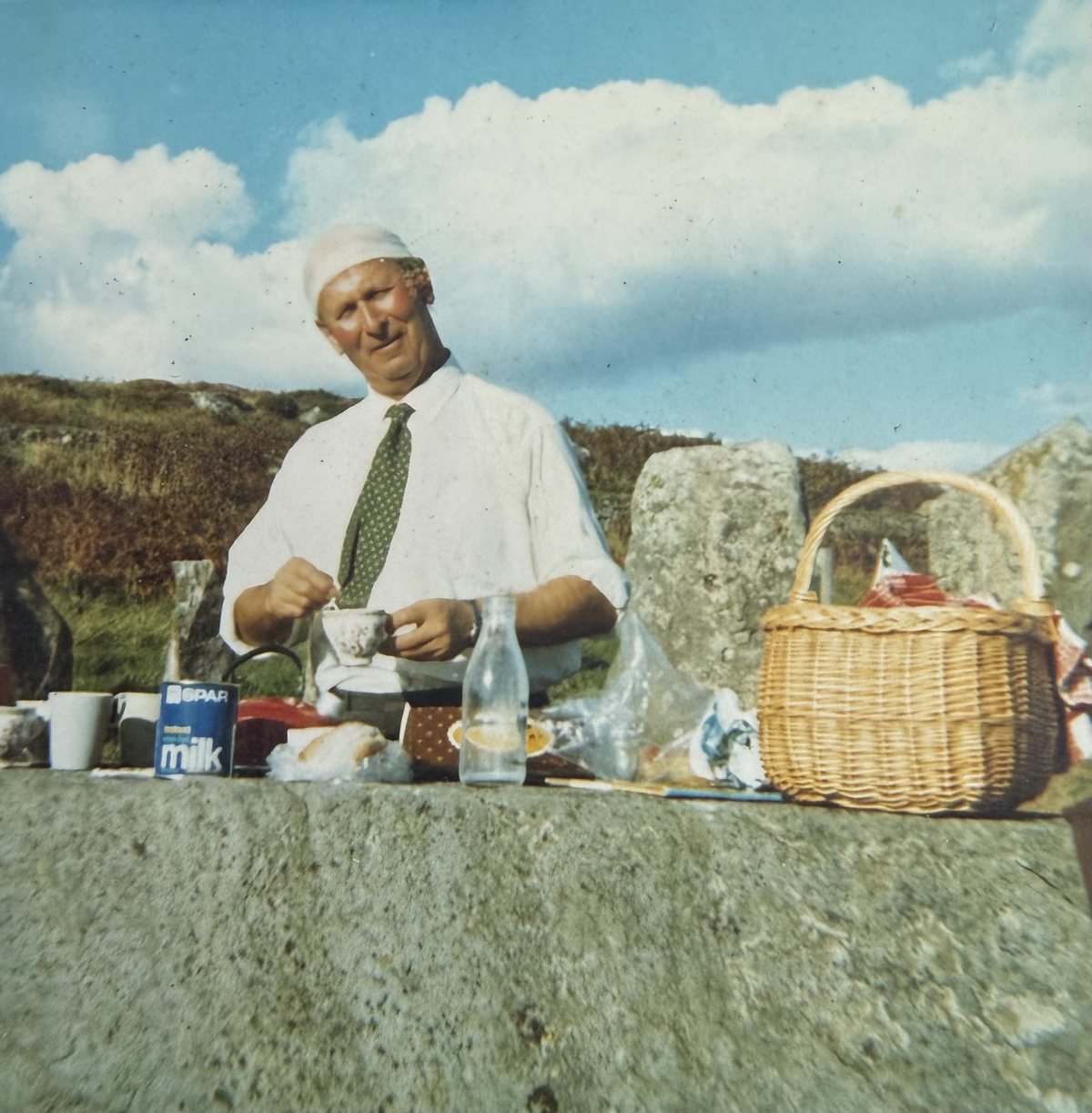
A man standing by a great flat stone in a field in West Cork, partaking in afternoon tea. He has a cup in one hand and a knotted handkerchief on his head against the sun, and he has the settled, unhurried look of a man doing something he has done many times before, in a place where he has every right to be. It is September 1970. The man is my great-uncle Herbert (Richard Herbert Jones, born in 1908, brother of my grandmother Alice), and the photograph lived in the family album alongside the weddings and the babies and the seafronts, one more picture among the rest. Nobody ever pointed at it. Nobody ever explained it. It needed no explanation, which is, I now understand, the most remarkable thing about it.
Because the stone Herbert is using as a tea table is the recumbent stone of the Drombeg stone circle: seventeen pillars of West Cork sandstone standing in a ring above Glandore, set there by people who were farming that hillside more than three thousand years ago. The long flat stone at the circle's south-west (the one placed to catch the midwinter sunset, the one the guidebooks photograph at solstice) is the altar. The locals' name for the whole monument, from long before the archaeologists arrived, is the Druids' Altar, and it comes with what one writer on Ireland's sacred stones calls a "rather dark reputation": the stories that cling to the recumbent stone are of sacrifice, and the excavators did find a burial at the circle's heart.
My family used it as a picnic table.
Not once, on some giddy Edwardian outing, but always: habitually, unremarkably, across generations. The circle stood on the land of Drombeg House, and from the early 1700s, the land belonged to the Joneses, my grandmother's people. For the better part of two and a half centuries the Druids' Altar sat inside the family's fields the way a pond or a good oak might: a fixture, a landmark, a place to spread a cloth on a fine day. The Bronze Age was part of the demesne.
Here is the detail I cannot leave alone. By the time that photograph was taken, none of it was theirs; and even that plain sentence, when I finally went to check it, refused to behave. When the house last came up for sale, the newspaper gave the family's exit as 1923, the very first year of the Irish Free State (one small gentry family's departure, made in the same season as the whole world that had produced it). It is a beautiful date, and the register disagrees. My grandmother's father died in the house in February 1944, aged seventy-one, his occupation entered as Gentleman, and the daughter recorded at his bedside was my grandmother. Whatever changed in 1923 changed on paper, over their heads, where the ownership of Irish land had mostly lived; the family stayed, and poured, for another generation. The circle would pass, in time, to the care of the state, which put up a sign and a car park, and made it what it is now: one of the most visited ancient monuments in Ireland. And still, a generation after the last of the family left the townland, my great-uncle walked out to the stones with a teacup and spread the afternoon on the altar, as his father had, and his grandfather, in a field that no longer knew him. The custom outlived the paperwork by half a century.
I want you to hold that image, because this book is in it. A family so entirely at home in deep time that it takes its tea on a Bronze Age altar; so unbothered by the ownership of the past that it goes on picnicking after the field has changed hands. Intimate, proprietorial, cheerful, and completely unexamined. We were at ease with three thousand years; we had checked none of it.
My father died in 2023. What he left me, along with everything else a father leaves, was boxes.
Box files with reams of printouts, disorganised files and envelopes. I want to be accurate about this, because the boxes are where the book begins: loose papers and photocopies soft at the folds from handling, letters kept in their slit envelopes, with the airmail stripes going pale. Nothing so grand as an archive. And when I found them, they had been living in my father's garage for years, covered in cobwebs and dust. Inside was the residue of a decade of quiet obsession: my father's hunt, begun in the early 1990s, for the answer to where we came from.
His name was Norman. He was Cork-born, a drummer in his early days (with the Axels and Taste), and in the early 1990s he set out to follow our surname home. He was aided, abetted and regularly contradicted by two cousins he mostly never met: Judy Wight in Utah, whose careful letters carried the American branch's research across the Atlantic a page at a time, and Edward "Ted" Dammery in Melbourne, who had written up his own history of the family in 1979 and held it with an author's confidence. Three researchers, three continents, one rare name that the three of them could not even agree on how to spell. Damery, Dammery, Damerie: the correspondence conducts a genial three-cornered argument about the very word at the top of the tree. As I would learn much later, the disagreement was itself ancestral: the family tradition operating exactly as it always had, in an age when clerks spelt by ear and a man's name could change its clothes between his baptism and his burial (sometimes only a year and a half later, written by the same clergyman!).
What they were all chasing (my father on and off, in and out of love with it, for the better part of ten years) was what I came to call the Damery prize. The name is rare. Rare names can be hunted. And this one, if you could only ride it far enough back, promised to arrive somewhere extraordinary: at Norman knights and a place called Daumeray on the Loir, at "de Dalmari" in Domesday Book itself. The prize was the unbroken line, the thousand-year pedigree, the name carried from the Conquest to Cork, and it glittered at the three of them out of every photocopied page, always one document out of reach.
The name never gave it up. It still hasn't: the wall at the head of my own surname stands almost exactly where my father left it, a man walking into Bandon around 1690 out of an England no record has yet named, and this book does not pull that wall down. That is where the book begins. It is not, as it turned out, where the book ends.
Among the papers in those boxes was a single photocopied page that I have returned to more times than any other. It is a sketch, copied by Ted, from who knows what original, and captioned in a careful hand: Arms of Damerie of Chappell. At the top there is a crest, a talbot's head, the old English hunting hound, drawn with real care. Beneath it the shield is drawn but not coloured: six wavy bars (barry nebuly, the heralds call it) crossed by a single upright stripe, every tincture left blank.
I have never found a better emblem for what I inherited. Here was the family's claim on the deep past (ancient, dignified, lovingly copied), and under it, holding it up, was nothing that anyone had ever proven. A shield without colours. A story without a floor.
The stories themselves I had come by from my father, my aunts, and my cousins. The way such things are properly transmitted: at the kitchen table, in passing, with total conviction and no citations. The name came over with the Conqueror; that was simply known. There had been Knights Templar and secret societies; there was an ancient coat of arms somewhere; someone buried at the Rock of Cashel, another at Tewkesbury Abbey; a King's gift; and a motto that belonged to us, Tu ne cede malis (yield not to misfortunes), which is a fine thing to be told over your tea when you are ten years old. I absorbed them the way Herbert absorbed the picnics: as furniture. It did not occur to me that they had never been checked, any more than it occurred to him to ask whose field he was taking his tea in.
The motto, I would discover, is Virgil. Aeneid, book six: the Sibyl speaking to Aeneas at the mouth of the underworld: tu ne cede malis, sed contra audentior ito. Yield not to misfortunes; go the bolder against them. Whoever first chose that line for the family chose better than they could have known, though I notice it took me until after my father's death to look the words up. That is roughly the ratio this book runs on: a family in confident possession of eight centuries of story, and nobody, in any generation, walking to the shelf to find out what the words actually said.
So the boxes sat there, and the sketch sat on top of them, and I did what the reader will already have guessed I did. I picked the whole thing up. I owed it to my father. To solve, or try to, what drove him mad. To find that coat of arms that he always wanted for himself.
But I made one decision first, and it is the spine of everything that follows. My father was a careful man in most things, but in this one pursuit he had wanted an answer too much, and I had watched from afar what the wanting did. It led him, at one point, to graft a whole borrowed limb onto the tree on the strength of a name and a hope (her name was Eliza Bell; she was nobody's ancestor of ours; she has a chapter coming). The wanting is the occupational disease of family history. Every genealogist catches it, because the whole enterprise runs on desire: you do not spend your evenings in parish registers unless some part of you wants the story to be true. You cannot help the wanting. The question is: what do you do when the document on the table disagrees?
So, one rule, set before I opened the first envelope, and never relaxed since:
Nothing becomes true just because we want it to be.
Everything in this book answers to that rule. Every ancestor who appears in these pages with a date attached has a record behind the date. Where a link is probable but unproven, the prose will say so, in those words. Where a story is tradition (cherished, inherited, unverifiable), it is kept and told and labelled as what it is, because a good family story is worth keeping as a story; it is only passing it off as fact that kills it. And when the rule and a beloved story collide (I will not pretend to you that they don't), the rule wins. In the third part of this book, the rule takes down the best story we had, the one I most wanted, the one whose loss cost me eight named ancestors in a single evening, and I will show you the documents that did it and let you watch it fall. That is the bargain: if the best story goes when the documents say so, you can trust the stories left standing. My father never quite managed it, and I think he knew he never quite managed it, and he is the reason I hold to it.
One more promise, while we are shaking hands. Nobody in this book will ever say anything they are not recorded as saying. There is no invented dialogue in these pages, no imagined interiority for the dead, none of the costume-drama upholstery that family histories reach for when the record runs thin. Where the record is silent, the silence is the content; and where I allow myself to imagine, for a paragraph, what something must have been like, the prose will tell you so. The dead cannot correct us. It seems the least we owe them.
What did the rule find? That is the book; I will not summarise it, but I will tell you its shape.
It found that the truth was stranger, funnier and finally better than the legends: the documented family contains a knight who married a king's niece and died in rebellion against him; a poet's sister; a Bible translator's grandfather who died "worth a plum"; a Cromwellian cornet and a Royalist officer whose blood, planted a few baronies apart in the 1650s, met in one Limerick parlour a century later; a rector who spent forty years unknowingly baptising the family his own descendants would marry into; a sea captain commended in a world war his country stayed out of. It found that the grandest chapters were not where the family had always looked, and that some of the poorest generations (the ones the legends skipped) were carrying the story's real weight the whole time. It found the boy who stayed behind when everyone else sailed, and it found the one word on an 1888 marriage certificate that rewrote thirty years of my father's work.
And then it did the thing I had least expected of a rule built to say no. On the side of the tree nobody had been watching (not the rare paternal name my father hunted, but on my grandmother's side, a line of West Cork and Limerick women whose maiden names the family had half forgotten), the same rule that had spent the book taking legends apart handed one back, intact, documented, and larger than anyone had dared to claim. The prize my father chased for a decade under the wrong name was real the whole time. It was simply on the other side of his tree, and it could only be reached by the discipline he could never quite hold to. I will show you the two royal doors I had to shut before I would trust the ones that opened, because it is the shut doors that make the open ones worth anything.
And it found the limits too, because the rule cuts both ways. There is a wall in this book that never falls (my own name's, where it all began). There are doors I will show you that stand ajar, keys named, waiting for a researcher I may never meet. Crowned at the top and unfinished at the root: that is the true shape of an honest family history, and it is the shape of this one.
The tea things have long been cleared from the altar; Herbert died in 1973; the album photograph is on my desk as I write this, and it is on the cover of this book. I look at it now, and I see two things at once. I see everything I come from: the ease, the continuity, the beautiful unexamined confidence of a family that believed it had always been there and always would be. And I see everything this book had to do, because somebody, eventually, in some generation, had to be the one to stop pouring, put the cup down, and ask the field the obvious, impossible, overdue question.
Whose is this? How long have we really been here? And what actually happened?
My father asked it first. He deserves that said upfront: he asked it first, and he asked it for ten years, and the boxes are the proof. What he could not quite do was accept the answers when they refused to match the wanting. And I understand, because some of the answers are hard, and one or two of them, as you will see, took things from me that I would have liked to keep. But one of them, the one he wanted most, I would have given a great deal to be able to hand him across the kitchen table. I can only write it down instead.
This is a book about an Irish family with a Norman name and a shelf of old stories, and about what survived, and what arrived, when one of its members finally checked. The motto says: yield not to misfortunes, go the bolder against them.
Very well. Audentior ito. Let us go and look.
Want to know when it's ready?
Write to hello@aynsleydamery.com and you'll be the first to hear.