The daughter who sealed the will
11 October 2026
Every road this tree takes to Brian Boru, to William the Lion and to the last king of Leinster crosses one rung: Constantia Piers, who married Rev. Vere Hunt in 1712. For years that rung rested on Burke's alone. It now rests on her mother's will, in a registered copy the fire of 1922 could not reach, with Constance's own seal on it.
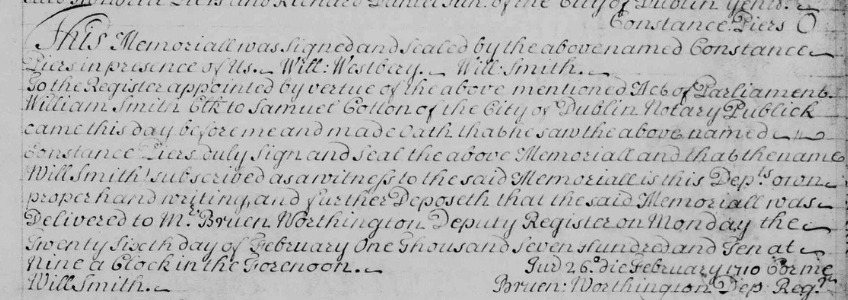
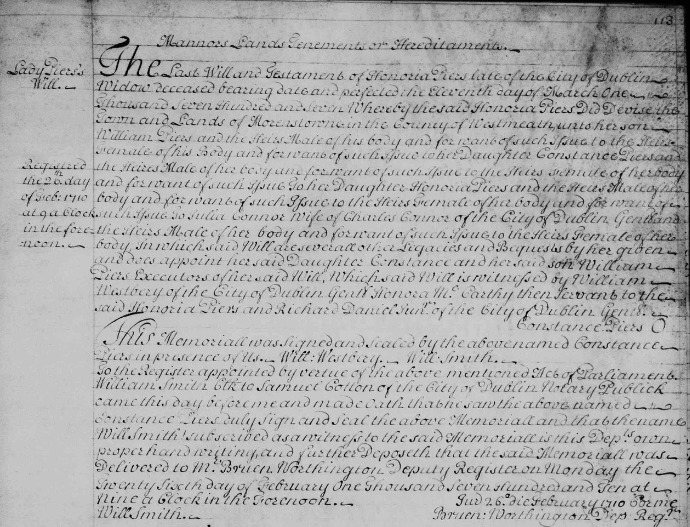
Readers who have followed the crowns up this tree will know that the grandest claims often hang on the quietest people. Here is the quietest of all. Constantia Piers married the Rev. Vere Hunt in 1712, and through her mother, Honora FitzMaurice, Lady Piers, runs every documented path this family has to the High King of Ireland, to the King of Scots and to the Kavanagh kings of Leinster. Take her out and the summit goes with her. And for as long as this site has stood, her place as Honora's daughter rested on the printed pedigrees, Burke's above all, which is a respectable footing and not a proof.
In June 1922 the Public Record Office at the Four Courts burned, and with it the probate copy of almost every early Irish will, including Honora's. That is usually where these stories end. But Ireland kept a second, stranger archive: the Registry of Deeds, where from 1708 people could register memorials of their documents, and the Registry did not burn. In September the research found what it had stopped hoping for, in a memorial registered in February 1710/11 and now imaged by the Virtual Record Treasury: the registered will of Honoria Piers of Dublin, widow, made the eleventh of March 1707/8.
The will devises the family's Westmeath lands rung by rung: to her son William, then to "her Daughter Constance Piers", then to her daughter Honoria. It names Constance an executor beside her brother. And then it does the thing no printed pedigree could ever do: at the foot of the memorial, among the seals, is Constance's own. The daughter this whole ascent depends on witnessed her place in it with wax, in her own hand, in her own lifetime.
There is even a second document to lock the identity. In the same volume, in the same fortnight, before the same two witnesses, "Constance Piers of the City of Dublin Spinster" lends two hundred pounds on lands in Louth: a legacy put out at interest by an unmarried woman with money, the year before her marriage to Vere Hunt. Same woman, twice, on the record.
The honest print, as ever: her father's identity still stands on Cokayne rather than parchment, but nothing royal turns on him; the ascent runs through her mother, and that is precisely the link the will proves. The chokepoint of the whole Irish and Scottish summit is no longer a line in Burke's. It is a primary record with a seal on it, and the seal is hers. The ladder she holds up is drawn on the tree.