The shield on the wax
10 August 2026
Seven hundred years ago a woman pressed the family arms into wax. The old heralds recorded her seal, and here it is again, redrawn by hand, carrying the coat that still stands under the name today.
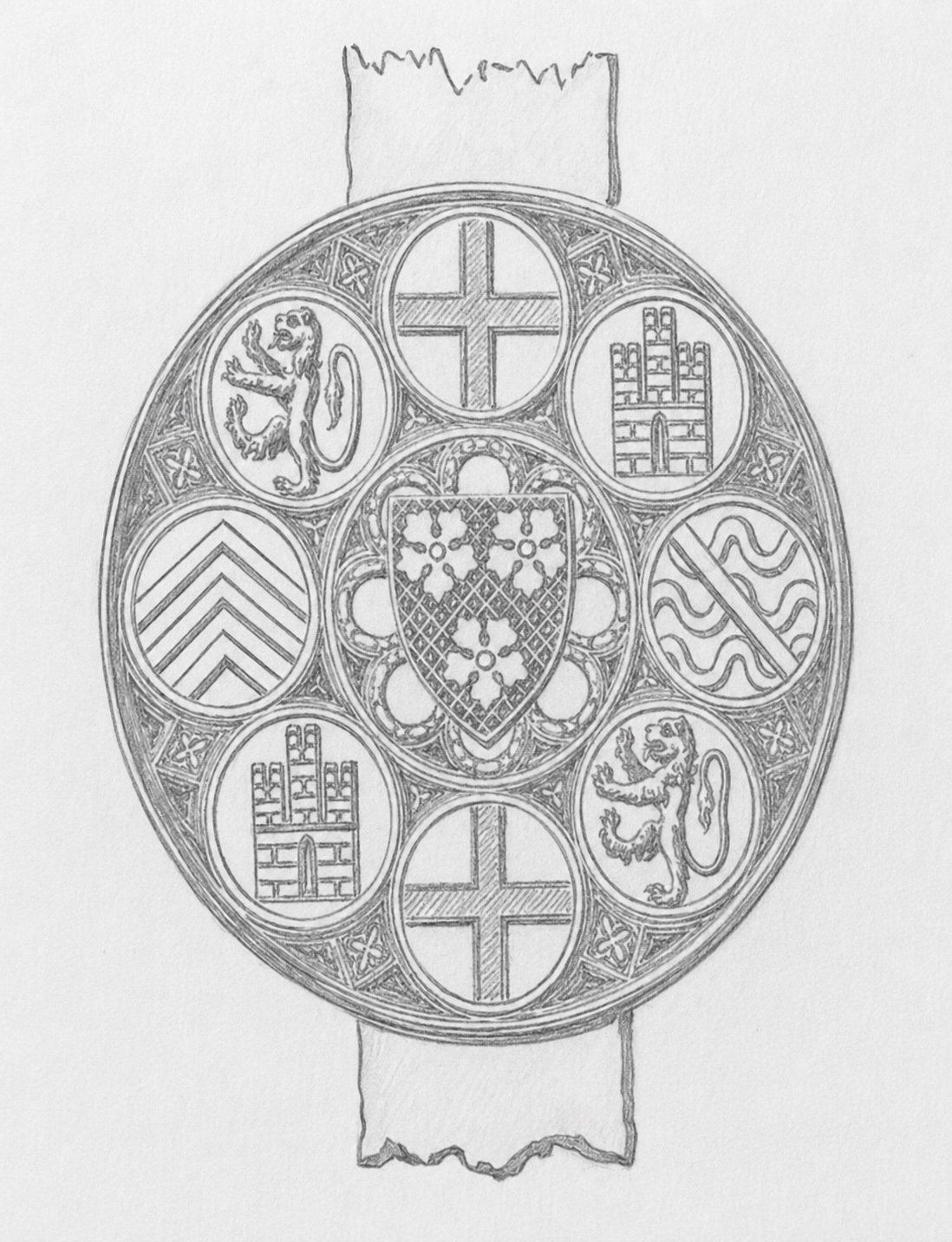
Her name was Elizabeth, and she was the daughter of Roger D'Amory, the fourteenth-century baron from whom this whole scattered surname takes its shape. She married John, Lord Bardolf, and somewhere before her death she sealed her letters with a small round seal that has outlived almost everything else about her. The old heralds drew it, and Charles Boutell printed it in his Heraldry as figure 299. The drawing above is that seal, redrawn here from Boutell by a hand seven centuries down the line.
Read it from the middle out and it tells you who she was. At the centre sits the shield of her husband's house, Bardolf, azure three cinquefoils or. Around it run roundels for the families that made her: D'Amory, her father, argent, three bars undy gules, over all a bend azure; De Clare, or, three chevronels gules; De Burgh, or, a cross gules; and, twice over, the castle and the lion of Castile and Leon. Boutell explains the little castles plainly. Elizabeth was a descendant of Edward the First and Eleanor of Castile, through their daughter Joan of Acre, who married Gilbert de Clare, Earl of Gloucester. The Spanish towers on an English lady's seal are her great-grandmother's, carried north and pressed into English wax.
For anyone who bears the name, it is the D'Amory roundel that matters. Those wavy red bars and that blue bend are the same coat that stands beneath the arms this family carries now, and beneath the book that carries its motto. The motto itself came later, added by the printed heralds of a much later age. The arms are older, and here they are in the flesh: not a claim, not a reconstruction, but a real coat on a real woman's seal, before the middle of the fourteenth century.
And there is a quiet turn in the seal worth naming, without dwelling on it. Of the houses gathered around its edge, this family descends by documented lines from most of them: from the de Clares, whom the research has climbed all the way to Domesday; from the de Burghs of the Irish marches; and from Edward the First and Eleanor of Castile themselves, whose castle and lion sit on the wax. It reaches them not through Lady Bardolf at all, but by other roads entirely, up the Butlers of Ormond and the old lines of Munster and Leinster. The single house on the seal it cannot prove it descends from is D'Amory, the very name it carries. The blood came in by the side doors, and the name walked in at the front.
However you spell it today, Damery or Damory, Dammery, D'Amery or Amory, this is the shield on the wax, and Elizabeth, Lady Bardolf, is the woman who carried it.