The three crowns of Ireland, first borne by a cousin
27 July 2026
The three crowns that stood for Ireland were first carried on the shield of a de Vere, the family this house descends from, six hundred years before the same house was shown to carry the blood of Ireland's own kings.
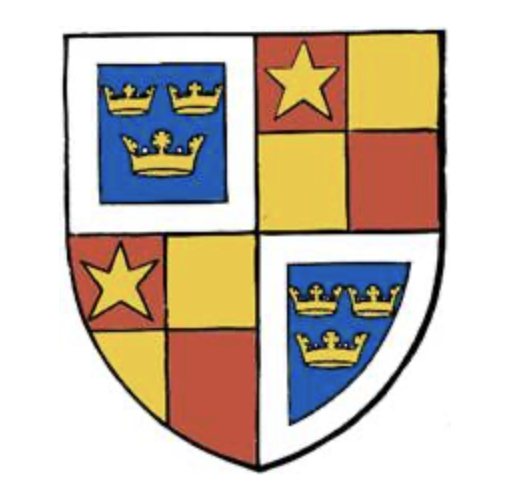
Here is a coincidence the research walked straight into, and it is worth a page of its own.
The three gold crowns on blue that served for centuries as the arms of Ireland have a first bearer, and he was a de Vere. In 1386 King Richard II made his favourite Robert de Vere, ninth Earl of Oxford, Duke of Ireland, the only man ever to hold that title, and granted him by letters patent of 3 January the right to quarter his own de Vere arms with a new blazon for the Irish office: azure, three crowns or, within a bordure argent. It is the earliest appearance of the three crowns for Ireland. The dukedom did not outlast the man: Robert backed the wrong side against the Lords Appellant, fled the country in 1387, lost the title the year after, and died abroad in 1392 with no children. Only one example of the arms is known to survive, on a floor tile found in Essex.
Now set that beside what this year proved. The de Veres are not a borrowed grandeur on this site; they are documented ancestors, up the line from Jane Vere of Gosfield to the Earls of Oxford. Robert, the Duke of Ireland, was the childless ninth Earl, and when he died the earldom passed sideways to his uncle Aubrey, the tenth Earl, who stands in the direct line, and on through Richard the eleventh Earl who commanded at Agincourt to Jane and to here. So the man who first bore the arms of Ireland was, in the plainest sense, a cousin of this family: the branch that died out so that mine could carry on.
And here is the turn. Six hundred years after a de Vere put the three crowns of Ireland on his shield as a matter of office, the same de Vere descent, joined to the Irish lines proven this summer, turns out to carry the thing the crowns only stood for. The actual blood of Ireland's kings: Brian Boru of Munster, Diarmait of Leinster, the Uí Dúnlainge kings back to Saint Patrick's century. The heraldic Ireland and the blood Ireland, three crowns painted on a tile in Essex and a High King who fell at Clontarf, meet in one family that did not know it held either until this year.
It is only a coincidence. The dukedom was Robert's, the blood came in by other doors entirely, and no herald planned the rhyme. But the family that has spent a summer learning how Irish it is, in blood it can now prove, once held the arms of Ireland too, on the shield of a cousin, long before anyone knew the blood was there to match them. This research keeps having accidents like that. This is the prettiest one yet.