Thirteen houses, twelve crowns
28 July 2026
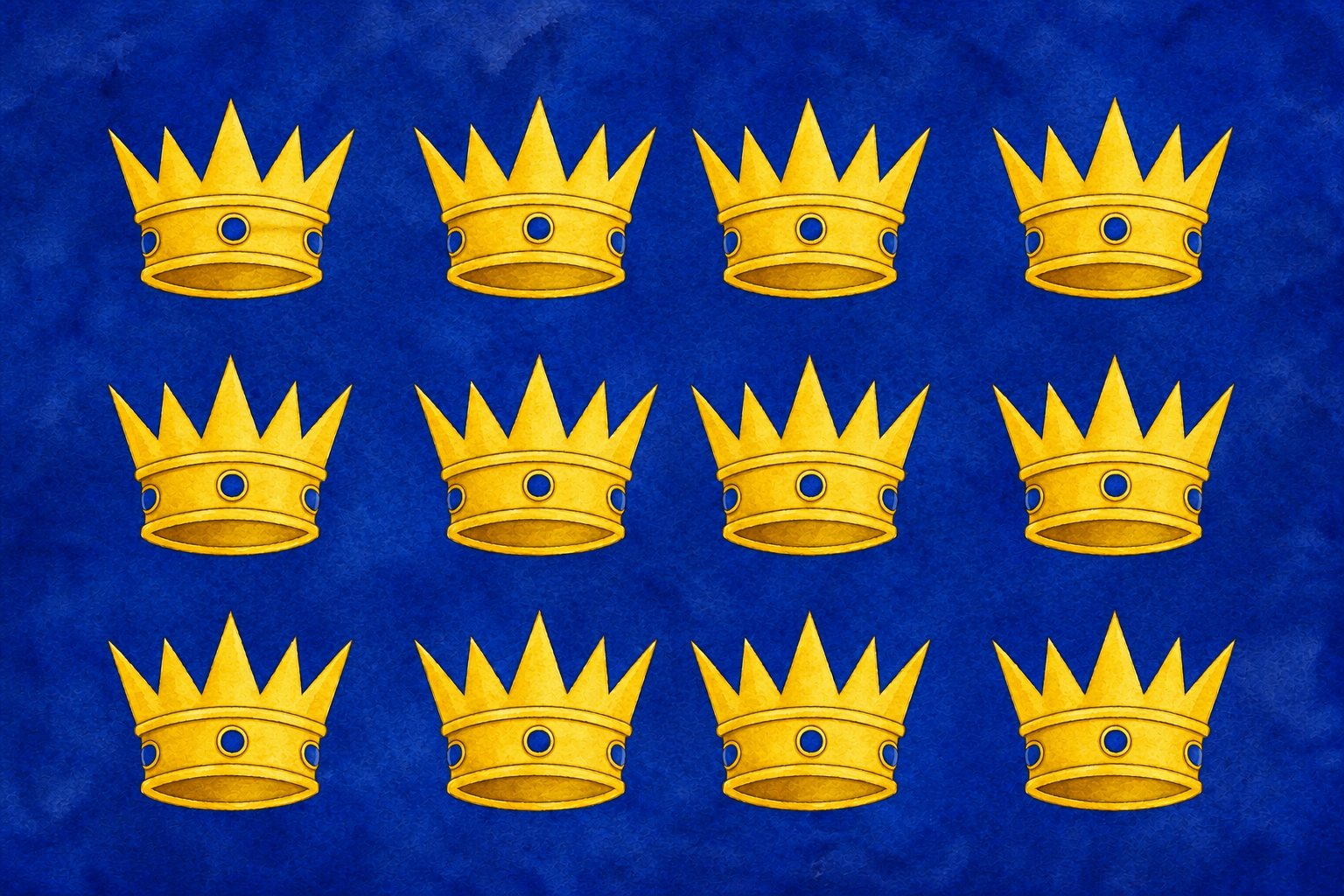
In the last week of July the research finished the climb it had been making all month. The summit is no longer a council of five or six crowns. It is thirteen royal houses and twelve sovereign crowns, from fifth-century Leinster to Plantagenet England, and every rung of it is graded.
When this Journal reported the first crowns a few days ago, I promised the failures would always be told first. That promise holds. The two royal doors that failed inspection, the childless Gaunt marriage and the Camoys line that carried no royal blood, are still shut, still on the site, still the credential. What has changed is everything above them.
In the last days of July the research wired the rest of the summit, and the count now stands at thirteen royal houses and twelve sovereign crowns in the documented direct line. The British Isles first: Alfred the Great and William the Conqueror, and now Edward I of the Plantagenets; Kenneth MacAlpin, reckoned the first King of Scots; Rhodri the Great and Hywel Dda the lawgiver in Wales; and Ireland's three kingships, the two Leinster dynasties and Brian Boru's Munster. Then the Continent: Charlemagne, now reached by two separate roads; his son Pepin, King of Italy; Hugh Capet of France; Vladimir the Great and Yaroslav the Wise, Grand Princes of Kiev; and Olof Skötkonung, the first christian King of Sweden. A family that spent thirty years hunting one line to the Conquest turns out to hold the crowns of seven countries.
They arrive, all of them, along just two family lines, and the two meet in the Hunts. The de Vere Earls of Oxford carry the crowns of the Continent, through one extraordinary woman named Isabel de Vermandois, who bundled the blood of France, Charlemagne and Kiev into a single marriage. And the O'Briens, FitzMaurices and Butlers carry the crowns of the islands, through the Butler Earls of Ormond, whose first Earl married a granddaughter of Edward I. The whole architecture is drawn, house by house and rung by rung, in The Royal Houses, and told in Chapter 26 of the living edition.
Each of these houses has its own story, and they deserve better than one breathless list. So the Journal will tell them properly over the coming days: the Plantagenet door that opened after two others were honestly shut; the Welsh princess the pedigrees call the Helen of Wales; the saint who carried the old English royal blood to Scotland; the Rus princess who became Queen of France; the Viking who became Normandy; and the nine barons of Magna Carta now standing in the direct line, among them the man the barons chose to lead their army.
One thing has not moved. At the bottom of all of it, one rung up from me, a man named Damery walks into Bandon about 1690 from an England no record has yet named. Thirteen royal houses now stand above him, and his own front door is still the one the family most wants opened. That proportion is the whole project, and it is why the crowns can be believed.