The Documented Family
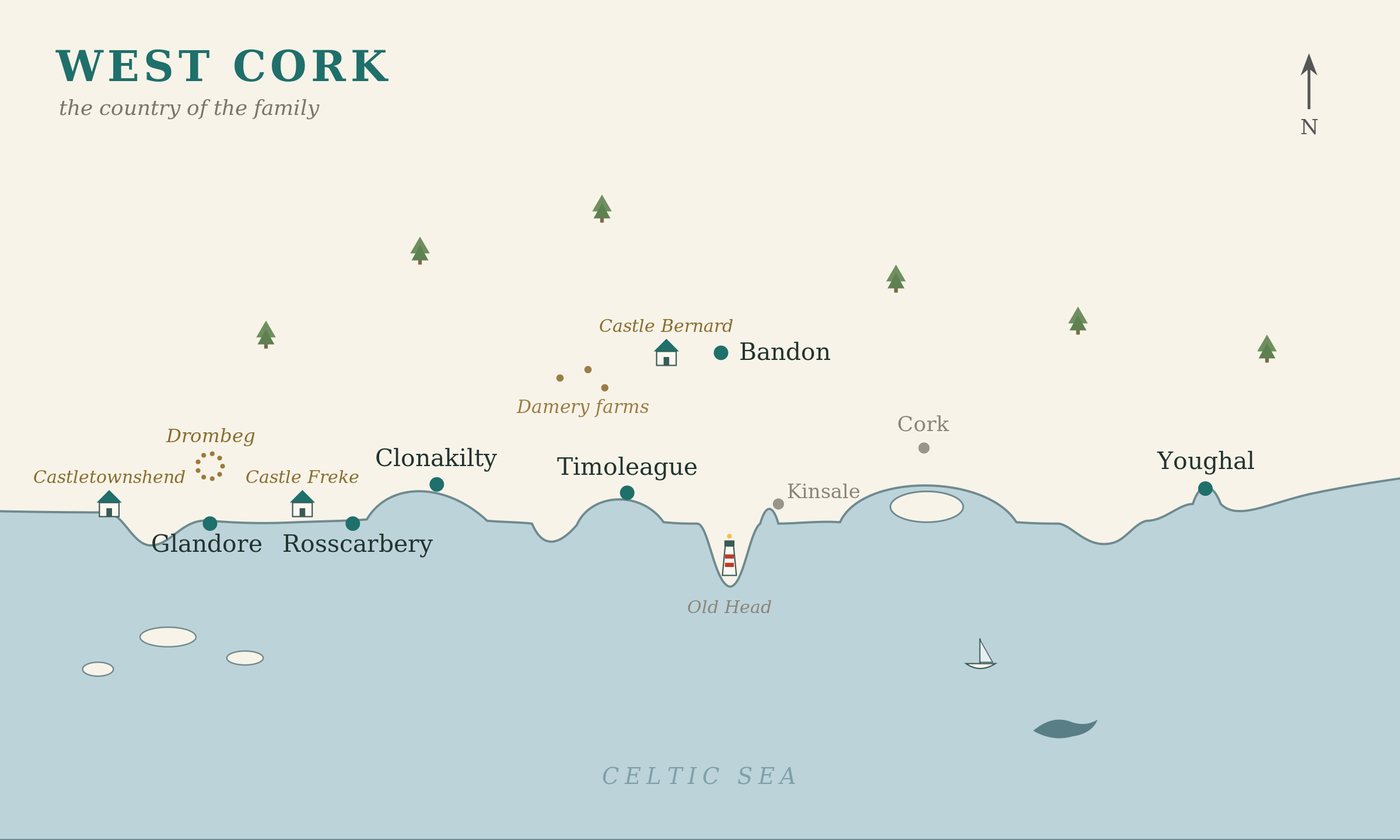
From here, the ground is firm. Each line below rests on records: parish registers, deeds, wills, and the great pedigrees of Burke, Brady and Kingsley, with the colourful true stories in teal boxes and the few loose ends marked in red.
A word first on the world these families shared. Almost everyone in this Part belongs to one small society: the English and Welsh Protestants planted in West Cork between the reign of Elizabeth and the wars of Cromwell, who took the forfeited land of Munster and held it for three hundred years.
How it came about is a story in four acts, and worth the telling, because it shaped every family in this Part. Munster had been the country of the Fitzgeralds, Earls of Desmond. When the last Earl rebelled and was destroyed (1579–83), the Crown declared his vast lands forfeit and opened the first great Plantation of Munster in 1586, parcelling nearly half a million acres among English "undertakers" who undertook to bring over English tenants.
Walter Raleigh took Youghal and Lismore; the poet Edmund Spenser took Kilcolman; and Phane Becher (whose name keeps recurring in these pages) took the seignory west of Bandon on which the Beamish would settle. That first plantation was half-burned in the rebellion of 1598, but under James I, it was renewed and fortified, and the planted towns rose, Bandon foremost among them.
Then came the cataclysm, the rising of 1641, in which the settlers garrisoned their houses, and many were burned out, and behind it Cromwell's reconquest, which confiscated Irish land afresh and paid it to his soldiers and to the "Adventurers" who had bankrolled the war. Colonel Townsend took his West Cork acres so, and, by tradition, so did the first Jones.
A last turn of the wheel followed the fall of James II in 1690–91, when Jacobite estates were forfeited in their turn and sold off, sometimes, as at Drombeg, through an English speculating company. Four confiscations in a century, and every family in this Part came in on one wave or another.
Their capital was Bandon, the walled Protestant town that Richard Boyle, the "Great" Earl of Cork, raised about 1604 and peopled with English and Welsh settlers, many of them cloth-workers from Somerset. It was so jealous of its faith that a couplet was said to be carved over its gate: "Turk, Jew or Atheist may enter here, but not a Papist" — to which a wit is supposed to have added below, "Whoever wrote this wrote it well, for the same is writ on the gates of Hell." Around it lay their demesnes, strung along the harbours and river valleys from Glandore and Rosscarbery in the west to Clonakilty, Timoleague and Youghal in the east.
It was a tight world and a small one: a few dozen families: Beamish, Bernard, Freke, Townsend, Travers, Hungerford, Jones, Smyth; all who farmed, soldiered, took holy orders and, above all, married one another, generation after generation, until the whole gentry of the district was a single cousinhood.
My own lines run through almost all of them; the Damerys, humbler, married at its edges. The chapters that follow take each family in turn, but they are really branches of one intermarried tree, rooted in a single corner of a single county.