The Damorys
The book opens on three sketches of the Damory arms. The descent they point to has now been proved, through thirty generations, from a manor in Oxfordshire to my grandmother at Drombeg.
This history opens on a sheet of photocopied sketches from the family papers: the arms of Robert Damory and his sons, of Roger Damory, and of Damory of Cotherington. For as long as anyone can remember the family has said it came from those people. For a long time I could say only that Roger Damory was kin by marriage. That has changed. Roger, Lord Damory, and his wife Elizabeth de Clare are my twenty times great-grandparents.
Bucknell
The Damorys were knights of Bucknell in Oxfordshire, tenants of the honour of d'Oilly. The first in the pedigree is Robert Damory, who was living in 1139 and gave land to the nuns of Godstow about a year earlier. Seven generations held the manor after him. One Robert was sheriff of Oxfordshire and constable of Oxford castle, and died in 1236. His son Roger mortgaged Bucknell to Oseney Abbey and redeemed it in 1271. Roger's son, Sir Robert, died in 1285 and left two boys.
Their arms are on record from that generation. A roll of the 1270s gives Robert three wavy bars of red on silver, with the black label of an heir whose father was still alive.
Two brothers
Richard, the elder, had the land. He became sheriff, constable of Oxford, and steward of the household to Edward II. Roger, the younger, had nothing but his sword. He was a knight by 1306, in the household of the Earl of Gloucester, and he rode at the Dunstable tournament of 1309 with a blue bend across the family coat to mark the younger son.
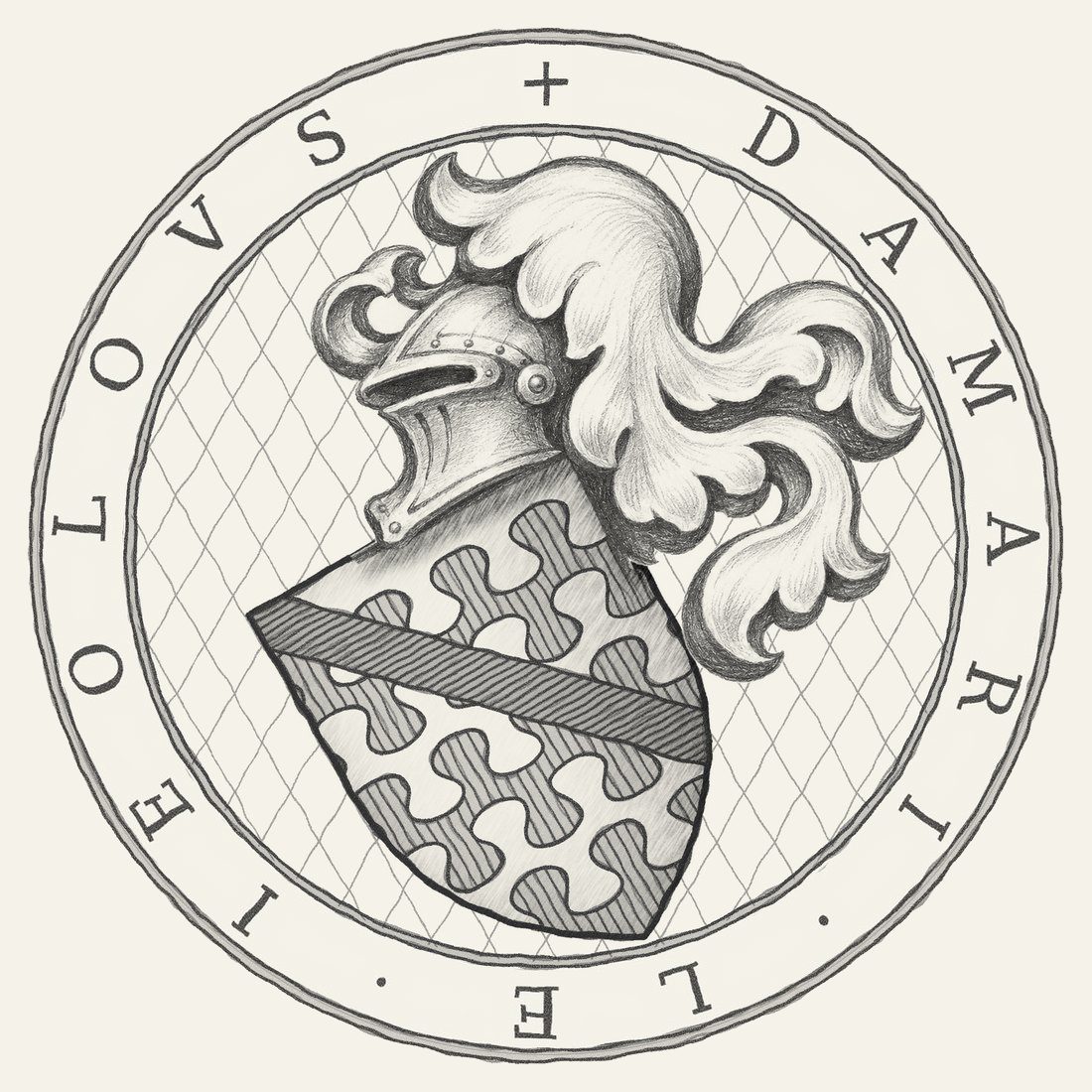
Gloucester was killed at Bannockburn in 1314. Roger fought there, and what he did caught the king's eye. Within three years Edward II had given him castles, money and manors, and in the spring of 1317 the king's own niece. She was Elizabeth de Clare, a granddaughter of Edward I, twice widowed at twenty-one, and one of the three sisters who shared the Gloucester inheritance. Roger was summoned to Parliament that November. Two days later he sealed a deed in London with a new seal: his shield under a helmet, and round it the words Damari le Ieolovs, Damory the zealous.
It lasted five years. The king found a new favourite in Hugh Despenser, who was married to Elizabeth's sister. Roger joined the rising against him and was taken at Tutbury in March 1322, sick or wounded. He was condemned to death as a traitor. The accounts differ on what came next. In one the king put the sentence off, because he had once loved him well. In another Roger was dead before it was pronounced. Either way he died at Tutbury within a day or two, and no executioner touched him.
The Lady of Clare
His widow was shut up in Barking Abbey and made to sign away her Welsh lands. She never married again. She lived thirty-eight more years and founded Clare College at Cambridge. For thirty of those years she went on sealing her letters with Roger's shield at the centre of her seal. In 1353 she changed to the arms the college still bears, her father's and her first husband's side by side, and even then she kept Roger's in the border.
They had one child, a daughter, Elizabeth, born in May 1318. She was married as a girl to John, Lord Bardolf of Wormegay in Norfolk. When her mother died in 1360 the inquests named her as Roger Damory's heir.
The road to Drombeg
From Lady Bardolf the line runs for nine generations through Norfolk and Suffolk: Bardolf, Stapleton of Ingham, Calthorpe, Drury, Jerningham, Cornwallis and Southwell. Among them are a Speaker of the Commons and a lady of Queen Mary's privy chamber.
Then it crosses to Ireland. Sir Thomas Southwell came to County Cork under James I for the plantation of Munster. His daughter Elizabeth married Sir John Dowdall and held Kilfinny Castle through the siege of 1642. Her daughter married Sir Hardress Waller, one of the judges who condemned Charles I. A Waller married an Evans of Miltown Castle in 1722, an Evans married a Lucas of Richfordstown in 1756, and in 1788 Dorothea Lucas married Richard Smyth of Castle Downeen, a few miles from Drombeg. Their granddaughter Eliza Hester Smyth married Harry Jones of Drombeg at Glandore on the last day of 1861. Her granddaughter was Alice Dorothy Jones, who married Alfred Norman Damery. She was my grandmother.
The route could be called circuitous, but every step has been verified. The record for each link is set out on the Damory descent page.
What it means
One question is left where it was. The Damery name is on record at Bandon from the 1690s, when Richard and Margaret Damery were burying family there, and the line is proven from Richard Damery of Ballymodan, born about 1720. Where they came from before Bandon is not yet known, and that search goes on.
The family was right all the same. The Damory blood is here, and it has been since a Smyth of Downeen married a Jones of Drombeg. My father, who kept those sketches, carried it without knowing where it came from.