The Ryves of Damory Court, and the Swaynes
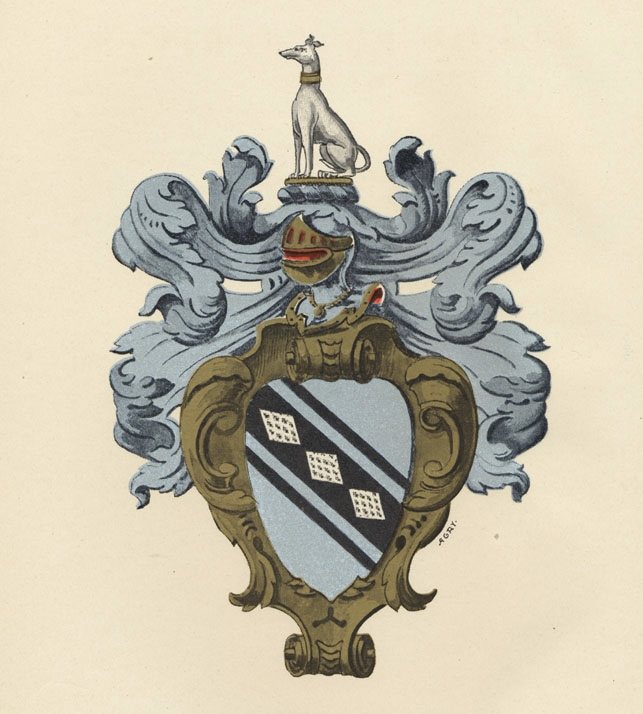
Twice in two generations my Frekes married a Swayne, and through the first of those marriages the family reaches into a corner of Dorset it would be a pity to pass over: for the house the Swaynes' own people held bears, of all names, a version of my own.
The Frekes of Shroton were a large family, and like all such families they married their neighbours. Robert Freke of Iwerne Courtney (the Exchequer man, d. 1592) took as his wife Alice Swayne, a daughter of John Swayne of Blandford Forum; and a generation later their son William Freke married Anne Swayne, a daughter of Arthur Swayne of Sarson in Hampshire. Whether the Blandford Swaynes and the Hampshire Swaynes were close kin I cannot show (the name was spread across Dorset, Wiltshire and Hampshire), but the Frekes plainly knew the Swaynes well enough to marry them twice over.
The Blandford Swaynes were not gentry but merchants on the rise. John Swayne (c. 1509–1591) came of Tarrant Gunville yeoman stock and made himself a wealthy Blandford trader with the Continent; his sons climbed with him. One, Robert Swayne, settled at Gunville; another, Richard Swayne (c. 1556–1636), sat in Parliament and was made the first Steward of Blandford for life when the town received its charter in 1606. It was John's daughter Alice who married my Robert Freke, and who died in April 1577, days after bearing William, the son who would carry the family to Ireland.
The Hampshire Swaynes were the grander branch. Arthur Swayne, Esquire of Sarson (1543–1609), in the parish of Amport, bought the manor of Sarson in 1598; Burke's "Sareen," and the very house where William Freke and Anne Swayne were living, and where most of their children were born, before they removed to Cork. Of Arthur's daughters, Anne is mine; her sister Mary married Sir Nicholas Hyde, Lord Chief Justice of England. So a Lord Chief Justice sat at my 11× great-grandfather's table as a son-in-law. (A documented marriage but it is my Swaynes marrying into Clarendon's Wiltshire Hydes; it brings no Hyde blood to my own line, and none of the royal kinship that a separate Hyde confusion can suggest. See "The Stuart queens.")
But it is John Swayne's wife who carries the line into its most curious house. She was Agnes Ryves, born 1512, a daughter of Robert Ryves of Damory Court.
The Ryves, and the house with my name
Robert Ryves (c. 1490 – 11 February 1551/2) is, by the careful reckoning of the Ryves scholars, the first of his name of whom there is any record in England, which makes him, at thirteen generations back, the deepest-documented ancestor in this whole book. He was a Blandford man who rose on the dissolution of the monasteries: in 1545 he bought the great estate of Ranston (Randleston, by Shroton), and in 1548 he bought, from the Duke of Somerset, the manor and house of Damory Court at Blandford Forum. He was a Teller of the Exchequer to Henry VIII. By one account he "died worth a plum, an immense fortune in those times”. And he lies, or lay, in the old church of St Peter and St Paul at Blandford, under a brass that Richard Symonds copied into his diary in 1644 before the great fire of 1731 swept church and town away.
His wife was Joan (d. 1560), and of their children my line runs through Agnes. The senior line, through his son John, kept Damory Court for two centuries and gave the nation an extraordinary run of public men: among them Dr George Ryves, Warden of New College and one of the translators of the King James Bible (see Part III), and Dr Bruno Ryves, chaplain to Charles I and Dean of Windsor.
The name of the Ryves' house is no small thing to a Damery. Damory Court at Blandford was, by Burke's account and by old Dorset tradition, the seat of Sir Roger d'Amory himself, the very knight of Part I, Edward II's favourite, who bore the bend azure of a younger son. Roger held Dorset offices to match: Constable of Corfe Castle in 1320–21, and Warden of the Forest of Purbeck, before he threw in his lot with Thomas of Lancaster's rebellion and died in 1322. The local memory of the d'Amory connection is alive even now, in a Blandford inn called The D'Amory Arms, kept in the old D'Amory Court Farmhouse.
So Roger d'Amory enters my story from two directions at once, and both run through my father’s parents. Through my grandfather's side, the d'Amory name and arms are the fountainhead of my own. A tradition, but the dearest one I own. On my grandmother's side, the Freke–Swayne–Ryves line married, in Agnes Ryves, into the family that held Roger d'Amory's own Dorset house. Two strands of my father’s family, sundered by centuries and the Irish Sea, meet on a single medieval knight. And there is a last touch I cannot resist: in his will of 1549, Robert Ryves spells his manor "Damery corte”; my own name, in a Dorset document, three full centuries before my Damerys surface at Bandon.
Two honest cautions hold this story to its proper grade. First, the name Damory Court is contested: Burke's and local history make it Roger d'Amory's seat, but the Survey of English Place-Names derives it instead from a medieval "Manor of Dame Marie" and the same old guides print both. It is a convergence of name and place, cherished as such, not a proven thing.
Second, it is no bloodline. The Ryves only bought Damory Court in 1548; they were not d'Amorys. I have searched the Ryves, Swayne and Damer pedigrees for any marriage between a Damery and a Ryves or Swayne, and found none. My name touches this house through its walls and its title-deeds, not through its blood. (And the old tale that the Ryves were French Huguenots "of the Languedoc" is itself a mare’s nest: it grew from a misread field-name, France Farm, which sits beside Damory Court to this day.)
The name clung to more than the house. A little way off, at the top of what is still Damory Court Street, there once stood the Damory Oak, by repute one of the greatest trees in England, old enough, they said, to have been a sapling in the tenth century. It rose some seventy-five feet, measured sixty-eight feet round at the foot, and had hollowed with age into a cavern fifteen feet across and seventeen high: room, it was claimed, for twenty men. During the Civil War an old fellow set up inside it and sold ale from the hollow; and after the Great Fire of Blandford in 1731 the trunk gave shelter to two families left homeless by the flames. A storm in 1703 tore away its greatest limbs, and by 1755 the old giant was past saving and sold for firewood for fourteen pounds. But the name outlived the tree, in a Damory Oak inn that stood at the street's foot within living memory. Not my family's tree, of course. It took its name, like the house, from the manor, but it is a fine thought all the same: that an oak grew, and poured ale, and sheltered the homeless, under my own name, in the very town where my Ryves forebears held their court.