The Smyths of Castle Dooneen
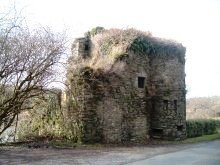
Harry Jones married Eliza Hester Smyth in 1861, of a West Cork clerical family. Her father, the Rev. John Richard Smyth (1796–1873), was Rector of Tullagh, of Castle Dooneen; and here the Lucas reappear, for his mother was Dorothea Lucas of Richfordstown, the same family the Travers had married a generation earlier (Chapter 4). The Smyths were also already in-laws of the Beamish: the same small circle, marrying round and round.
The Rev. John Richard Smyth's wife (my 3× great-grandmother) was Anne Hickey (c. 1798–1869), and her father brings this clerical line home to Damery ground in a way I did not see coming. He was the Rev. Ambrose Hickey, D.D. (1750–1826): son of Noah Hickey, schooled by Dr Benson, Trinity College Dublin from 1767, Doctor of Divinity in 1803 and, for the last forty years of his life, Rector of Ballymoney (1784–96) and then of Murragh (1796–1826).
In 1787 he married Jane Herrick of Shippool (the old Herrick place on the tidal Bandon below Innishannon), a daughter of Falkiner Herrick (1729–1775) by his first wife Sarah Bousfield of Cork; and Burke's, which I have now read for myself, sets it down in so many words: "Jane, m. Rev. Ambrose Hickey." Anne was their daughter; her brother was the Rev. William Hickey (1787–1875), who as "Martin Doyle" became one of the most celebrated agricultural writers in nineteenth-century Ireland, a one-man improvement society with a Dictionary of Irish Biography entry to his name.
Sit with the geography of that appointment for a moment.
Ballymoney and Murragh are not just any West Cork parishes; they are the Damery home country, the very ground where my father's people were farming as tenants through exactly those decades.
For forty years, the rector who kept the registers of the parishes around Tullyglass (christening, marrying and burying the neighbours of my Damerys, perhaps Damerys themselves) was Ambrose Hickey: my own 4× great-grandfather on the other, maternal-Jones side of the family.
The two halves of my father's ancestry, gentry-clerical and tenant-farmer, were not merely working the same county; one of them was quite possibly writing the other into the parish books. Neither could have imagined that their lines would one day meet in me. (Grade:(Grade: Ambrose's career is from Alumni Dublinenses; the Herrick marriage is now confirmed in Burke's. Any Damery entries in his registers remain to be looked for.)
Jane's people go back, on the page of Burke's, four generations more. The founder was John Herrick (b. 1612), who "accompanied the Duke of Ormonde to Ireland" in 1641, the very year of the great rising, and lived to 1689. His son Gershom (1665–1730) married an heiress, Susanna Smart, the only child of Smithin Smart by Frances Riggs of Riggsdale (Bandon-river country again). Gershom's son Edward (b. 1694) married Elizabeth Falkiner, daughter of Caleb Falkiner of the Cork merchant dynasty, and that marriage explains the splendid forename of my ancestor Falkiner Herrick, who was simply carrying his mother's surname. The family paid the century's price for its red coats and blue: Falkiner's brother Edward, a Royal Navy lieutenant, was killed aboard the Dorsetshire in Hawke's action of 1759, and Jane's own brother Francis, a captain of the 27th, fell at Guadaloupe in 1795. And there is one more thread to smile at: a Herrick of the junior (Coolkirkey) branch married, in 1749, a daughter of Jasper Lucas of Richfordstown, the same Lucas family that appears elsewhere in this very chapter as the Smyths' kin. West Cork was a small world, and my ancestors kept marrying across it.
The English origin of John Herrick (1612) is not given by Burke's. Tradition attaches the Cork Herricks to the Herricks of Leicestershire (the family of Robert Herrick the poet), but no record I have seen joins them. A pleasing thought, kept firmly on the tradition side of the ledger.