The Whites of Kilmoylan, with the Ievers, Lanes, Huleatts and Pennefathers
My great-grandmother Alice Blanche White brought in a Limerick gentry and military family. Her father, Hugh Brady White (1847–1884) (my 2× great-grandfather), was a Surgeon in the Army Medical Department. His line is documented back through Newport White (1806–1853), Richard White (1769–1821), Newport White (1728–1780), who built Kilmoylan, the Rev. Newport White, John White of Cappaghwhite, to Simon White, Mayor of Limerick in 1696.
And the wives of that chain, now traced, each bring a county family of their own: Newport the builder married Mary Ievers, eldest daughter of Col. Henry Ievers of Mount Ievers, Co. Clare; their son Richard married Anne Hamilton Lane of Lanespark, Co. Tipperary, (Burke’s, with unexpected candour, preserving the family's description of her as "an enormously large woman”) whose mother was a sister of Sir Vere Hunt, 1st Baronet, of the de Vere Hunts of Curragh Chase; and Richard's son Newport married Mary Huleatt, whose mother's people, the Pennefathers of Marlow, ran back to a Cromwellian cornet buried at the Rock of Cashel. Three of the four are told below.
Hugh Brady White served in Jamaica (where his eldest daughter was born) and then in India, and died of cholera at St Thomas’s Mount, Madras, in 1884, aged just thirty-seven, one of the many British medical officers the disease carried off in India.
Mary Ievers came of a family on the rise. Her great-grandfather Henry Ivers arrived in Ireland as a clerk to the King's Commissioners, and by canny service was granted over a thousand acres of Clare in 1667 and two thousand more in 1678.
His grandson (Mary's father) Col. Henry Ievers (1696–1758) was a Trinity doctor of laws, High Sheriff of Clare at twenty-four, High Sheriff and then Mayor of Limerick, and Colonel of the Clare Militia Dragoons; and in 1733 he pulled down the old tower house of Ballyarrilla and raised in its place Mount Ievers Court, a tall house modelled on Chevening in Kent, employing half the stonemasons of the county for four years.
The house wears two faces, and both tell of Henry's dealings. The entrance front is of faded pink-red brick, shipped from Holland as ballast and paid for in rapeseed oil pressed at his mill on the O’Garney. The garden front, almost its twin, is of local limestone ashlar of a silvery hue. A fireplace of 1648, saved from the old tower, still stands in its hall. Mary was his daughter by his first wife, Anne Craven; widowed of my Newport White in 1780, she married a Mr Harding of Dromsally secondly. The house stands today, little altered and is one of the loveliest Georgian houses in Ireland, and my 5× great-grandmother's childhood home.
Anne Hamilton Lane's people are the most storied of the White wives, and Burke's, read in the original, brings the story closer than I had dared claim. The Lanes of Bentley Hall, Staffordshire, are the family of Jane Lane, "celebrated," as Burke's has it, "by her spirited conduct in saving the life of King Charles II after the battle of Worcester”, riding from Bentley toward Bristol with the fugitive King disguised as her manservant on the horse before her. Her brother, Colonel John Lane, had received the King at Bentley and contrived the escape; for these services, the family's arms were augmented with the three lions of England on a canton, and their crest was made a strawberry roan horse bearing the royal crown between its forelegs (the horse that carried a King). The Restoration granted the Colonel and Jane pensions (paid, Burke's notes drily, "with arrears constantly owing"), and tradition says he was offered a peerage and declined it.
And here is the sentence that matters to this book. Listing the children of Thomas Lane of Bentley (d. 1660) and Anne Bagot of Blithfield, Burke's names the Colonel; Jane; Richard, a groom of the bedchamber; and "William, from whom the Irish branch of the family derives." The Irish branch is mine: William Lane, one of the "49 officers" of the King's Irish service, granted Killeens (renamed Lanes Park) in 1666, whose line runs William II (d. 1698), Ambrose (d. 1724/6), Col. John Lane of Lanes Park (m. Elizabeth Bunbury of Kilreacle), John Hamilton Lane (m. 1783 Jane Hunt, sister of Sir Vere Hunt, 1st Bt), and so to my Anne. A "49 officer" was by definition a man who had served the King in Ireland before June 1649; and the Irish Lanes bore the Bentley arms undifferenced, with the old motto Fide et Amore, for as long as they lasted. If Burke's sentence is right, Jane Lane, the woman who saved a king, was the sister of my 9× great-grandfather. Whether it is right is the subject of the next box and of the sharpest piece of detective work in this book.
Now the grade, and it is the hardest-won in this book. Burke's, the Chester Herald, and Wrottesley all record the Irish founder as William of Shelton, son of Thomas and Anne Bagot (Jane Lane's own brother), and the Irish Lanes bore the Bentley arms undifferenced.
But when I went behind the printed pedigrees, the contemporary witnesses dismantled the claim piece by piece. Gregory King (compiling around 1683, from the family itself) records William of Shelton alive in England in that very year, "aged 60 and upwards," married to a Collins, with three daughters and no sons, and not a word of Ireland: eleven years after my Irish founder died at Cattiganstown leaving a boy of thirteen.
My founder's own will of 1672 leaves a remainder to "his nephew William Lane, son of his brother John Lane, one of His Majesty's servants”. Yet Colonel John Lane, dead in 1667, left one son, Thomas, and eight daughters: no William, no fit.
And the Chester Herald's own book betrays the graft: his William of Shelton "settled in Ireland in 1667" a year after my founder, a "49 officer" who had served in Ireland since before 1649, took his grant and "died in 1700 leaving Ambrose, Matthew and Gilbert," who are provably the sons of a different William, the founder's boy, dead in 1698.
Two Williams, stitched into one by a herald who was himself a Lane. So the honest position: my Lanes claimed the Bentley kinship, wore its arms, and were not alone. Another Cork family, the Lanes of Vernon Mount, claimed the very same descent, and some real connection through an undocumented cadet of that scattered family may well exist.
But the claim as printed cannot stand, and I have detached it from my proven tree. What remains open is a better question: who was the '49 officer? Four Lanes stand on the '49 lists: Richard, Thomas, William, and a Major Lane, and one of them is my 9× great-grandfather.
And here is what the claim, if it ever proves, would carry with it. Thomas Lane's wife (Jane Lane's mother) was Anne Bagot of Blithfield, daughter of Walter Bagot (1557–1622/3), Sheriff of Staffordshire, whose family had held Blithfield since the fourteenth century and hold it still: the Bagots are among the oldest documented families in England, with a male line claimed back to the Bagod of Domesday Book. And Walter's wife was Elizabeth Cave of Stanford, whose mother Margaret Cecil was the sister of William Cecil, Lord Burghley, Elizabeth I's Lord High Treasurer. So the family that sheltered a Stuart king in 1651 was itself, two generations back, kin to the minister who had guarded the Tudor queen. A and Jane Lane rode to Bristol carrying, along with the disguised Charles II, a great-aunt's worth of Cecil blood. The famous Bagot correspondence at the Folger Shakespeare Library is this very Walter's postbag. None of this is presently my pedigree. It is the inheritance sitting on the far side of one unproven join, which is precisely why that join heads the list of questions I leave to whoever digs next. My father chased Domesday down the Damery road and never got there; it would be a fine joke of history if it lay all along at the end of a Staffordshire lane.
The fourth wife's line outreaches them all.
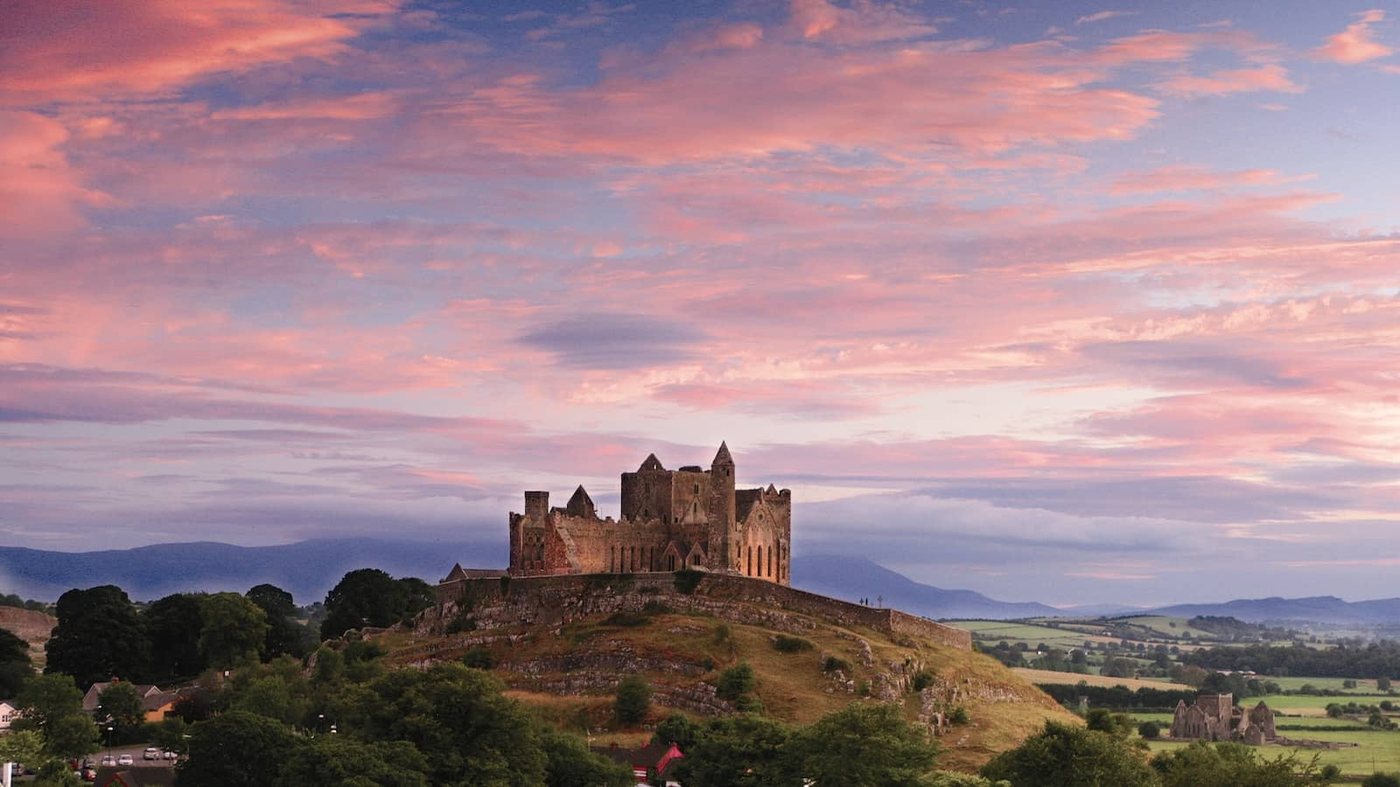
Mary Huleatt's mother was Ellen Pennefather (c. 1787–?), born at Marlow, Co. Tipperary; and the Pennefathers of Marlow descend from Cornet Matthew Pennefather (1618–1688), son of Abraham Pennefather of Staffordshire stock. His elder brother Abraham stayed at Hanbury-on-the-Hill while the Cornet rode with Cromwell's army into Ireland in about 1648. He served as quartermaster in the Earl of Mountrath's regiment, was granted some 1,237 acres about Cashel, and lies buried at the Rock of Cashel itself.
His son Matthew married Levina Kingsmill, daughter of William Kingsmill, M.P., of Ballybeg Abbey, and heiress of Ballyowen (renamed New Park). Of their three sons, the second was "gallantly distinguished at Oudenarde" under Marlborough. While the third, William of Marlow (d. 1772), who married Anne Taylor of Noan in 1734, begins my own descent through his second son John, to John's only son Thomas Pennefather of Marlow (1760–1825). Thomas came into Marlow when his uncle died unmarried and married Mary Moore, daughter of the Venerable Edward Moore of Mooresfort, Archdeacon of Emly, in November 1783. Ellen, born about four years into that marriage, is their daughter, and Burke's closes its list of Thomas's children with the very words this chapter needed: "Ellen, m. Rev. Hugh Brady Huleatt." (A granddaughter of the house later married the 5th Earl of Antrim.)
So the same corner of Tipperary gives me, in two adjacent generations of White wives, a Royalist "49 officer" (Lane) and a Cromwellian cornet (Pennefather): men who took opposite sides of the great quarrel, planted a few baronies apart, whose blood met at last in a Limerick parlour.
The Huleatts of Clare
That surgeon's "Hugh Brady" is itself a small genealogy. It came down to him from his grandfather, the Rev. Hugh Brady Huleatt (1783–1867), a Co. Clare clergyman and Rector of Ballyvaughan, who had it, in turn, from his grandfather, Hugh Brady of Raheen. A Christian name can be a thread you pull: follow "Hugh Brady" back, and the Huleatts of Clare and the Bradys of Raheen come up on the line behind it.