The Elliotts and Condons of Cork
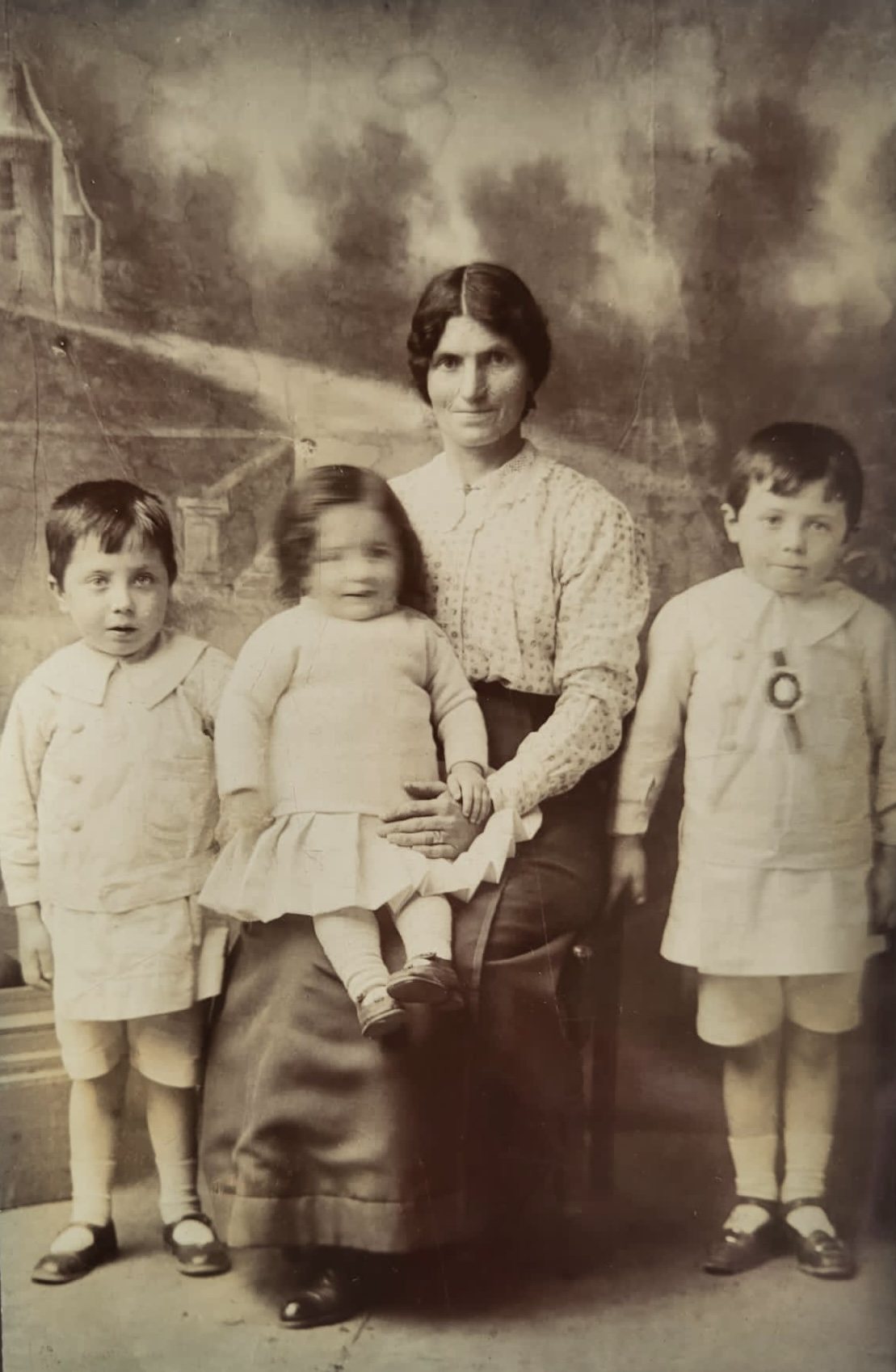
My mother's father was John Francis Elliott, born in November 1908 at 30 Quaker Road, Cork. To reach his people is to braid together two very different Corks: a family of weavers in the city, and a family of farmers off the West Cork land who sent a daughter into town. The two were joined in 1907, when John Francis's parents married.
Cornelius Elliott, weaver's son and soldier
John Francis's father was Cornelius Elliott, born on 24 February 1876 at 7 Blarney Street, in the old weaving quarter under Shandon. His own father (my 2× great-grandfather) was John Elliott, weaver: one of the last men of a craft that had once made that hillside hum, for Blarney Street and its lanes had been the heart of Cork's textile trade for two centuries. Elliott is an uncommon surname among Catholic Corkonians (more often an Ulster name), which makes this little family of Blarney Street weavers quietly distinctive.
John had married, on 4 November 1865, at St Patrick's church in Cork city, Honora Sheehan, a countrywoman, born on 30 September 1842, out at Castlemagner, a farming parish in north Cork near Kanturk. She was the anchor of the family for sixty years, outliving her century: she died in Cork in December 1926, in her mid-eighties. It was her maiden name, "Honora Elliott formerly Sheehan," written into Cornelius's 1876 birth entry, that let me fix her as his mother beyond doubt.
And the full civil copy of that 1865 marriage entry, when I finally held it, gave one gift more. Honora's father is named: Cornelius Sheehan, labourer. For as long as I had known my great-grandfather's name, Cornelius had seemed an odd fit among all these Johns and Roberts and here was its source, plain in the register: the boy was named for his mother's father. The entry gives the wedding its texture too: John twenty-three and a labourer of Forster's Lane, Honora twenty-one and in service off Bird's Quay; neither the bride nor the witnesses, Robert Tayler and Margaret Callaghan, could write their names, each mark attested by the clerk. Two young working people of the Cork quays, set down exactly as they were.
John Elliott's two occupations in the records (weaver in some years, labourer in others) are not a man's story but an industry's. Hand-loom weaving, the old skilled staple of the Shandon hillside, was dying through exactly his working lifetime, undercut by the power-mills. All over these islands, weavers of his generation took whatever work the city offered when the looms fell quiet, and went back to the loom when there was cloth to be made. That he appears in the registers under both trades is the economic history of nineteenth-century Cork written in one man's entries. He kept his family, raised his son on the same street as the craft, and is set down here by the older and prouder of his two titles: John Elliott, weaver.
Cornelius worked with his hands, as nearly every man of Blarney Street did, but it was the army, not the loom, that shaped his life, and his service papers tell it in full. On 4 June 1894, three months past his eighteenth birthday, he walked into the Cork recruiting office and took the Queen's shilling: five foot four and a half, nine stone four, fresh-complexioned, blue-eyed, a scar over the right eye, the medical officer set it all down, and his father, John Elliott of 36 Warren's Place, went into the book as next of kin. He became a driver in the Royal Artillery (the man on the horses that pulled the guns) and served his full twelve years, nearly three of them at war: South Africa, from September 1899 to September 1902. His medals map the war itself: the Queen's South Africa Medal with clasps for Paardeberg, Driefontein, Johannesburg and the Cape Colony, and the King's Medal for 1901 and 1902. Discharged in June 1906 with his twelve years done, he came home to Cork and married Julia almost exactly a year later.
Then, in September 1914, a married man of thirty-eight with three small sons, he volunteered again, weeks into the next war: Driver 91628, Royal Horse Artillery. His medal card gives the date he entered France, 18 December 1914, a week before the war's first Christmas. And from January 1916 his war was the one Ireland remembers least: Mesopotamia. Basrah and Baghdad, the heat, the fevers and the hospitals, twice invalided across to India and twice returned to the front. He came home from Basrah in March 1919 and then did the most telling thing in all these papers: a fortnight after his discharge he signed on a third time, as a Pioneer in the Royal Engineers, for the sad rearward work of clearing France, and came home for good in April 1920, a lance-corporal, to his trade as a stonecutter's labourer. The demobilisation papers list the family waiting at 30 Evergreen Buildings: his wife Julia, and the boys John (1908), James (1912) and Cornelius (1913). My grandfather John Francis was the eldest, a boy who was six when his father left for the second war and eleven when he finally stayed home.
His medals for that war came in the soldier's standard trio: the 1914–15 Star, the British War Medal and the Victory Medal and the war did not quite leave him. From October 1920 the Ministry of Pensions paid him a thirty-per-cent disability pension, "debility... aggravated by service": twelve shillings a week, with eight and tenpence for Julia and the boys, renewed year by year into the mid-1920s. He had already cleared France, carrying the debility the pension board would later put a number on. It is the quiet ledger of what some twenty-two years in uniform had cost.
Family memory sent both Cornelius and his father to a war in China, and I chased it through the War Records. Through every page of three engagements, there is no China. But the hunt turned up exactly where the story came from. On the medal roll of the Second China War of 1856–60 stands a genuine sailor named Cornelius S. Elliott, gunner's mate of HMS Amethyst. He was born at Poole, in Dorset, in 1825, and he cannot be ours, for the simplest reason in this whole book: our family had no Cornelius at all until 1876, when the name arrived from his mother's father, Cornelius Sheehan. A rare name, a medal and a war: the record-matching sites offer such men to every family tree that will take them, and somewhere along the line one was taken. The papers turned out better than the legend; not China, but Paardeberg, Basrah and Baghdad.
Before Blarney Street: the road from Golden
For as long as I had these records, John Elliott the weaver began and ended in Cork: a name on his son's marriage entry, a trade, a wedding at St Patrick's in 1865, and nothing behind him. It took my aunt Jeanne (an Elliott by marriage and a genealogist by conviction) one Sunday in July 2026 to hand me what may be three more generations, sent to my phone one register photograph at a time.
Her account ran like this, and by the end of the same day, it was no longer just an account. John the weaver was not Cork-born at all, but a Tipperary man: baptised at Golden, Co. Tipperary, on 10 April 1842 (and a twin). The National Library's register image is a joy: "Jn. & Jas., of Robt. Elliot & Julia Connors, sponsors Wm. Holmes & Margt. Ryan, Francis Enright & Cathn. Connors, Golden." Two boys at one christening: John and James, sons of Robert Elliott and Julia (Julianna) Connors, who had themselves married at Golden on 16 April 1836. That register image survives too, with John Connors and John Cleary standing as witnesses. Around the twins came Mary (1836), Catherine (1839) and Thomas (1844). If this identification holds, my John left Golden for the city sometime in his youth. One more country boy walking into Cork to learn a trade. And so the weaver of Blarney Street was a farmer's son from the Golden Vale.
Everything in this section hangs from a single link: that the John baptised at Golden in 1842 is the John Elliott who married Honora Sheehan at St Patrick's, Cork, in 1865. The Golden records themselves were documented from the first: the 1836 marriage and the 1842 twin baptism are photographed from the registers. But the identification of the Golden twin with the Cork weaver was Jeanne's, from her tree, and she would be the first to say so. There was a clean way to settle it: the 1865 marriage fell after civil registration of Catholic marriages began, and the civil register names fathers. I set the test in writing before I looked: if it says Robert, the chain is proven; if it says anything else, this section comes out. And then I pulled the register copy the same evening. Cork North East, St Patrick's, entry 113, 4 November 1865: John Elliott, aged twenty-three, bachelor, labourer, of Forster's Lane - father, ROBERT ELLIOTT, labourer. Twenty-three in November 1865 is a birth in 1842, to the year. The join holds; the generations at Golden are proven. (The links above Golden, Robert junior to Robert Senior of Birr, keep their own honest grades below.)
Robert Senior, Alice Acres, and a house of two churches
Behind Robert of Golden, Jeanne's account climbs twice more. Robert's father, "Robert Senior" in her telling, was baptised at Birr, Co. Offaly, on 8 March 1774, son of John Elliott and Elizabeth Evans; the rootsireland transcript survives. His wife was Alice Acres, baptised 18 September 1791 at Drumakeenon, in the parish of Ettagh on the Roscrea side of the Offaly–Tipperary border, Church of Ireland, daughter of Henry Acres and Sarah Charles, the register signed off by the rector, Rev Thomas Lestrange. Alice lived until 7 November 1860, by Jeanne's tree. Robert Senior and Alice raised their family at Golden: Robert (about 1812, our line), John (1814), Henry (1816), Anne (1825), and Eliza, and it is a small, pleasing corroboration that a son was named Henry for Alice's father.
And behind Robert Senior stands one generation more: John Elliott of Birr and Elizabeth Evans, married in the diocese of Killaloe in 1771. And this record, which began the day as the softest in the section, ended it documented. The Public Record Office's index of Killaloe marriage licence bonds carries the entry plainly: "Evans, Eliz.th and John Elliott, 1771." The bond itself burned with the Four Courts in 1922, as nearly everything did, but the index attests that the licence was taken out. And a licence bond was a Church of Ireland instrument, which quietly corroborates the whole shape of this section: a Protestant family in the Birr borderland, a generation before the road to Golden. Their Birr children are on the transcripts: Robert (1774), Sarah (1779), Elizabeth (1782), and John (1786), each naming Elizabeth Evans as mother. That John Elliott, fl. 1770s Birr, is now the farthest man on my mother's father's line.
And the same index page holds one small gift more: "Evans, Mary and George Acres, 1774." An Evans marrying an Acres, in the same diocese, three years after our John and Elizabeth. The same two families that would join again at Golden when Robert Elliott married Alice Acres. Two threads between two houses, a generation apart. It proves nothing on its own; it is exactly the kind of coincidence that, in a small Protestant community around Birr and Roscrea, is usually not one.
And the Acres page of the very same index closed the ring. There, among a whole clan of Killaloe Acres, Adam and Sarah Whitten in 1779, James and Sarah Clarke the same year, John and Margaret St Ledger in 1795, stands the entry this section needed: "Acres, Alice and Robert Elliott, 1813." Robert Senior and Alice's marriage, which began as an unsourced line in a family tree, is now documented by a licence bond; and the dates now run like clockwork: married in 1813, with their children arriving at Golden from 1814. Better still, those children's names keep the old naming rule perfectly; first son John for Robert's father, John of Birr; second son Henry for Alice's father, Henry Acres. The registers and the naming customs are telling the same story.
What remains unproven is the single step in the middle: that our Robert of Golden, who married Julianna Connors in 1836, was a son of this documented 1813 couple. No baptism for him has yet been produced, and two small tensions keep me honest: his claimed birth "about 1812" falls before his supposed parents' 1813 bond, so that estimate must be soft, or the placement wrong and by the naming rule a son Robert (his father's own name) belongs third, born around 1818–20, which would make him a young groom in 1836. Neither tension is fatal; both point at the same two records: Robert junior's baptism, and the source behind that "1812". Until one of them surfaces, this one link (and everything above it) keeps its honest tilde.
There is a quiet turn inside these records that no one in the family ever mentioned. Alice Acres was baptised Church of Ireland; her husband's people at Birr have no denomination recorded, but the Acres of Ettagh were Protestant beyond doubt. Yet at Golden, forty years on, Robert and Julianna Connors married in the Roman Catholic chapel, and every child of theirs was christened there. Somewhere between the Birr borderland and the Golden Vale, perhaps at Robert junior's own marriage to a Connors, a thoroughly Catholic name, the family crossed from one church to the other, in the direction that cost social standing rather than gained it. Mixed marriages were commonplace enough in the Irish midlands; what the registers cannot tell us is whether this one raised eyebrows at either altar. I record it as the registers give it, and note only that by the time the line reached Blarney Street it was as Catholic as the street itself. And it settles, at last, the small puzzle I flagged when I started this: why a Catholic household of the Cork lanes carried so un-Catholic a surname, "more often an Ulster name." The answer was sitting two counties away: it had not always been a Catholic household. The name kept the memory the family itself had let go.
The record-matching sites offer a fifth child of John and Elizabeth: one "David Mcelliot", baptised 1 September 1777 at Carrigeen in Cahir parish. The wrong end of Tipperary, Roman Catholic, under a different form of the surname. Wrong county, wrong church, wrong name: I take it for a false match on the mother's name and leave it out. If a real David of Birr ever surfaces, he will be welcome.
The soldier, the weighmaster, and three photographs
Jeanne's gifts did not stop at 1786, and by the end of the same long day her military hints had been run fully to ground. The results belong to the rewritten Cornelius passage and its box (part 5 of this file): his twenty-two years in uniform stand documented from attestation to pension, while the "China" of family memory turned out to belong to a Poole-born sailor who was never ours. Of John the weaver's own claimed soldiering, no record survived the checks. Every candidate (a Cork-born 5th Foot pensioner off to Jersey in 1848 among them) failed on plain chronology, and a man born in 1842 could not, in any case, have fought a war that ended in 1902 as family memory had it. What still stands of Jeanne's account of John is the civil claim, entirely plausible and still to be tested: that he worked in later life as a weighmaster in Cork. A question for Guy's Directory, the same pages that will one day settle the Bowdren building-firm memory) along with his death, which her tree gives as 1918, and Julia's as 1951. And best of all: Jeanne supplied, Pat Elliott’s photograph of an Elliott in Boer War uniform (now, on the service papers, probably Cornelius, in Royal Artillery kit) and photographs of Julia (Condon) with her young Elliott boys, one of whom is my grandfather.
Julia Condon, the farmer's daughter from Kilmalooda
Cornelius's wife (my great-grandmother, and the woman my own mother was named for) was Julia Mary Condon. By her 1907 marriage she was a shop assistant on Old George's Street in the city, one of the countless country daughters who came into Cork to work and lodged respectably near their shops; but she had been born on a West Cork farm.
On 22 November 1871, at Farran in the parish of Kilmalooda, near Clonakilty, a Julia Condon was registered, daughter of James Condon, farmer, and his wife Honora, née Dineen. Her father's trade (farmer, the very word given again on Julia's 1907 marriage) is what marks her out from the several other Julia Condons in the Cork registers, and her birth interlocks neatly with her parents' own: James Condon and Honora Dineen had married nine months before, on 11 February 1871 at Bandon, so Julia was their firstborn.
Behind them stand two more West Cork farmers, both named on that Bandon marriage register: John Condon, James's father, and Patrick Dineen, Honora’s, the latter standing as witness to his daughter's wedding. So the Condon line runs back, four generations deep, into the small farms around Kilmalooda, Clonakilty and Bandon.
There is a quiet symmetry here worth pausing on. My father's people (the Damerys of Tullyglass, and the Joneses of Drombeg, who married into them) farmed the country around Bandon, Rosscarbery, Glandore and Drombeg. My mother's Condons farmed Kilmalooda, a few miles in between on the same coast near Clonakilty. Generations before my parents ever met, and entirely unknown to one another, the two halves of my family were working the same corner of West Cork ground. The land drew them both to the city in the end, but they began within an afternoon's walk of each other.
The Condon chain is documented: the 1871 marriage and the 1871 birth confirm one another, and the fathers are named. The one soft join is the link between that Julia Condon of Kilmalooda and my Julia, Cornelius's wife. It rests on the match of her name and her father's name and trade (James Condon, farmer), not on a single record naming them as the same woman. It is as strong as such circumstantial identifications get; everything about the Kilmalooda Julia fits the Julia of the 1907 register, to the year. But I set it down for what it is. (An earlier candidate, a Julia Condon born in the city in 1872 to a father of a different trade, I have rejected: wrong trade, wrong place.)
Cornelius and Julia married on 25 June 1907 at SS Peter and Paul’s. She was thirty-five, he thirty-one, a match of two grown people who knew their own minds, and made their home at Evergreen Buildings, on the rising ground of Cork's south side. There my grandfather John Francis Elliott grew up; and there, a few streets off, lived the family he would marry into.