The Bowdrens and Treacys of Cork
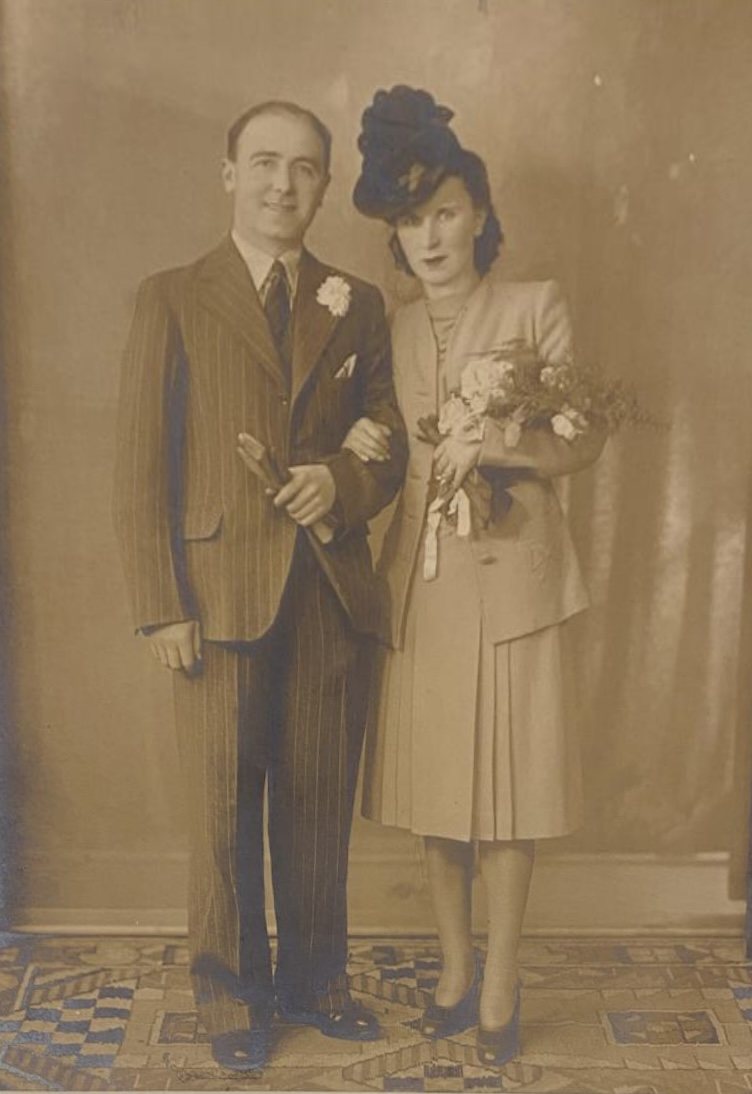
My mother's mother was Hanora (“Nora” or “Noreen”) Bowdren, born on 24 April 1920 at 37 Boyces Street, Cork, and she came of stone. On both sides, Noreen's people were masons: the Bowdrens and the Treacys were two Cork families of the same demanding, skilled trade (a craft served by apprenticeship and carried for life), and in 1902 they married into one another. To walk Noreen's line is to walk among the men who cut and laid the stone of Victorian and Edwardian Cork: the quays, the churches, the terraces the city still lives in.
The Bowdrens: three generations of masons, and a Wexford man
Noreen's father was Eugene Bowdren, born about 1879, a mason of 57 Evergreen Street. His father (my 2× great-grandfather) was James Bowdren, and here the trade runs unbroken: James was a stonemason, and his father again, Michael Bowdren, was a mason too, named as such on James's marriage register. Three generations of the chisel and the plumb-line, one after another in a craft where a name was a reference, that continuity was itself a testimonial.
James was not a Cork man by birth. The 1901 census records him as born in County Wexford, about 1841. So, somewhere in the 1860s, a young Wexford mason made his way to Cork with his trade in his hands and stayed. A travelling mason was no drifter: masons went where the building was, and Cork in the 1860s was building. On 30 November 1867, at the North Cathedral, he married Mary Callaghan of Coppinger's Lane, a farmer's daughter (John Callaghan's) then in service in the city, as most young countrywomen of her generation were before marriage. They raised a large family on Evergreen Street: the 1901 census finds them there with seven grown children about them, a whole household of masons and their sisters. Eugene, our man, was one of the sons.
The Bowdren name is a rare one and an old one: by the surname scholars' account, an Anglo-Norman toponymic, de Boderan, belonging to the Waterford and east-Cork borderland, first recorded in the seventeenth century around Dungarvan and Lismore.
The family has long kept its own framed telling of the name's arrival (a shipwrecked Swiss baker called Bowdern), and though the scholars read the record differently, the frame on the wall says something the documents cannot: that this family has cared about where it came from for a very long time.
One thread of the scholars' own account points to a place in County Wexford, which is striking, because my James was Wexford-born. The name travelled, too: whole branches of Bowdrens went out from the Waterford–Cork country to America and to Bell Island, Newfoundland, and their descendants still keep the name. My James almost certainly springs from the same mason stock at some remove. There is a documented family of Bowdren masons around Rathcormac and Bartlemy, headed by a Thomas Bowdren, in exactly the right country, but I have not yet found the join, and I will not invent it. He arrives in my story, honestly, as a Wexford mason walking into Cork with a trade the city wanted.
Eugene Bowdren's wife (Noreen’s mother, my great-grandmother) was Mary Anne Treacy, born about 1881, a dressmaker of Daly's Lane: a skilled needle in a family of skilled hands. Her father, George Treacy, was a tradesman and stonemason; the 1901 census shows him at the head of a household whose sons (Benjamin, Christie and Timothy) were every one of them masons, with Mary Anne the dressmaker among them: five trades under one roof.
George himself had married on 29 April 1865, at the North Cathedral, Mary Farrell, daughter of John Farrell of the city. George's own father was Benjamin Treacy, another tradesman. So the Treacy line, like the Bowdren, reaches back through the building trades as far as the records go. (The clerk of 1865 wrote the name down as Tracy, but the family knew their own: George signed his 1901 census form Treacy in his own hand; the 1902 register married Mary Anne Treacy, daughter of George Treacy, witnessed by Christie Treacy; and Noreen's 1920 birth entry reads formerly Treacy. A man's signature outranks a clerk's ear and so Treacy it is, throughout this book.)
On 1 June 1902, at the same North Cathedral where both their parents had married a generation before, Eugene Bowdren and Mary Anne Treacy were wed. The witnesses tell the whole story in miniature: Christie Treacy, the bride's mason brother, and Bridget Bowdren, the groom's sister. Two great Cork families of the same trade, sealing the match between them. From that marriage came Noreen, in 1920.
There is a family memory that one of this line, a Treacy or a Bowdren woman (possibly Amry Anne), ran "a big building firm in Cork." I have not yet found the firm in print, and I hold the story at arm's length until I do. But it sits very comfortably on the evidence (this is a family of masons, top to bottom): Michael, James and Eugene Bowdren, and Benjamin and George Treacy, with all his mason sons, exactly the kind of clan from which a family building concern would grow. If a widow kept such a firm going in her own name, as many did, the memory would be sound. The place to settle it is Guy's Directory of Cork, where a "Bowdren" or "Treacy, builder" would be listed; that search remains to be done.
Where the two lines meet
And here the two chapters close as one. Noreen Bowdren, the mason's daughter of the city's south side, married John Francis Elliott, the weaver-and-soldier's son of Evergreen Buildings. Neighbours, very nearly, on the same Cork hillside, for the Bowdrens' Evergreen Street and the Elliotts' Evergreen Buildings were the same rising ground. They married in 1942, at Clogheen. Their daughter was my mother, Julia Mary Elliott, born in 1944 and named for the great-grandmother from Kilmalooda. And it was she who, in time, carried this whole line of Cork masons, weavers and West Cork farmers into the Damery family, and to me. When I set the family motto at the head of this book, I had these people as much in mind as any knight: nobody in these two chapters ever yielded to anything.