The greatest knight
27 September 2026
William Marshal, Earl of Pembroke and Regent of England, the man a contemporary poem calls the greatest knight who ever lived, already stood in the documented direct line through three of his daughters. The August research added a fourth, and her road onward carries three more of history's set pieces before it rejoins the tree.
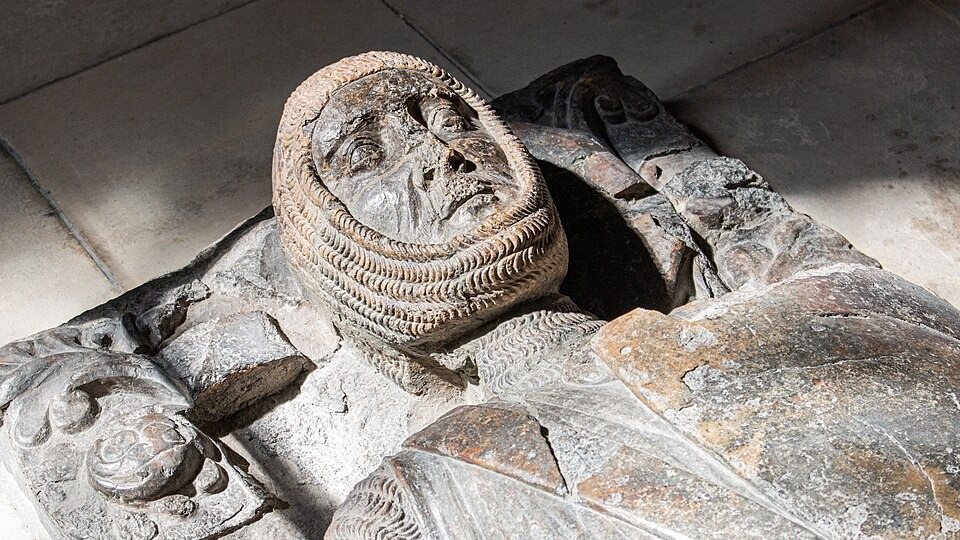
The August research broadened the Raleigh ascent, and one of the new lines runs to a name that needs no pedigree to introduce it. William Marshal began as the landless fourth son of a minor baron, was very nearly hanged as a small boy when his father cheerfully told King Stephen he had the anvils to make more sons, and rose by the tournament lance through the service of four kings to become Earl of Pembroke and, at seventy, Regent of England: the man who won the battle of Lincoln, reissued Magna Carta under his own seal, and saved the Plantagenet crown for a nine-year-old. The poem commissioned at his death calls him the best knight who ever lived, and eight hundred years of historians have mostly let the claim stand.
The family's road runs through his marriage, and the marriage is the Irish part of the story. His wife was Isabel de Clare, daughter of Strongbow by Aoife of Leinster, which means the Marshal door does what the grandest doors in this tree keep doing: it braids straight back to Diarmait Mac Murchada, the King of Leinster who was an ancestor here long before the Marshals arrived. Their five sons each held the earldom in turn and every one died childless, a run so unlikely that the age blamed a curse laid by an Irish bishop. The five daughters became the coheirs, and this tree, which already carried Maud, Isabel and Eva Marshal, has now been handed a fourth: Joan, the fifth and youngest, placed there not by guesswork but by the Complete Peerage, which trusts the French poem's ordering over the usual one. Four of the five coheiresses of the greatest knight in England now stand in one Cork family's direct line, which is pedigree collapse doing what it does best: turning a boast into arithmetic.
The road onward from Joan refuses to calm down. Her daughter Joan de Munchensi married William de Valence, half-brother of King Henry III; his mother was Isabella of Angouleme, King John's widow, who is already in this tree as John's queen, so that line folds back into a bed the research knew. Their daughter Joan de Valence married John Comyn of Badenoch, the Red Comyn, claimant to the Scottish crown, stabbed to death by Robert the Bruce before the altar of the Greyfriars at Dumfries in 1306; his mother was Eleanor Balliol, sister of King John Balliol of Scotland, which is why Bruce feared him enough to kill him in a church. And the Red Comyn's daughter Elizabeth, heiress to Goodrich Castle, was seized and imprisoned by the Despensers until she signed her inheritance away, whereupon her husband Richard Talbot took it back by force and the family simply kept it.
One post, four set pieces: the Regent of England, a murder before an altar, a kidnapped heiress, and a braid back to Leinster. Every rung is graded and sourced in the notes, and the whole ascent is drawn on the tree and placed among the royal houses. Where each of these lines finally stops being royal is a question with its own new chart, Where the crowns stop.