The hogshead at Enniskeane
18 November 2026
The earliest dated document that puts named Damerys on the Ballineen ground is a proclamation of the Lords Justices and Council of Ireland, given at Dublin on 14 December 1750, offering rewards for thirteen men found by an inquest to be guilty of the murder of Derby Cullinane at Enniskeane. Two of them are John and Andrew Dammery, labourers.
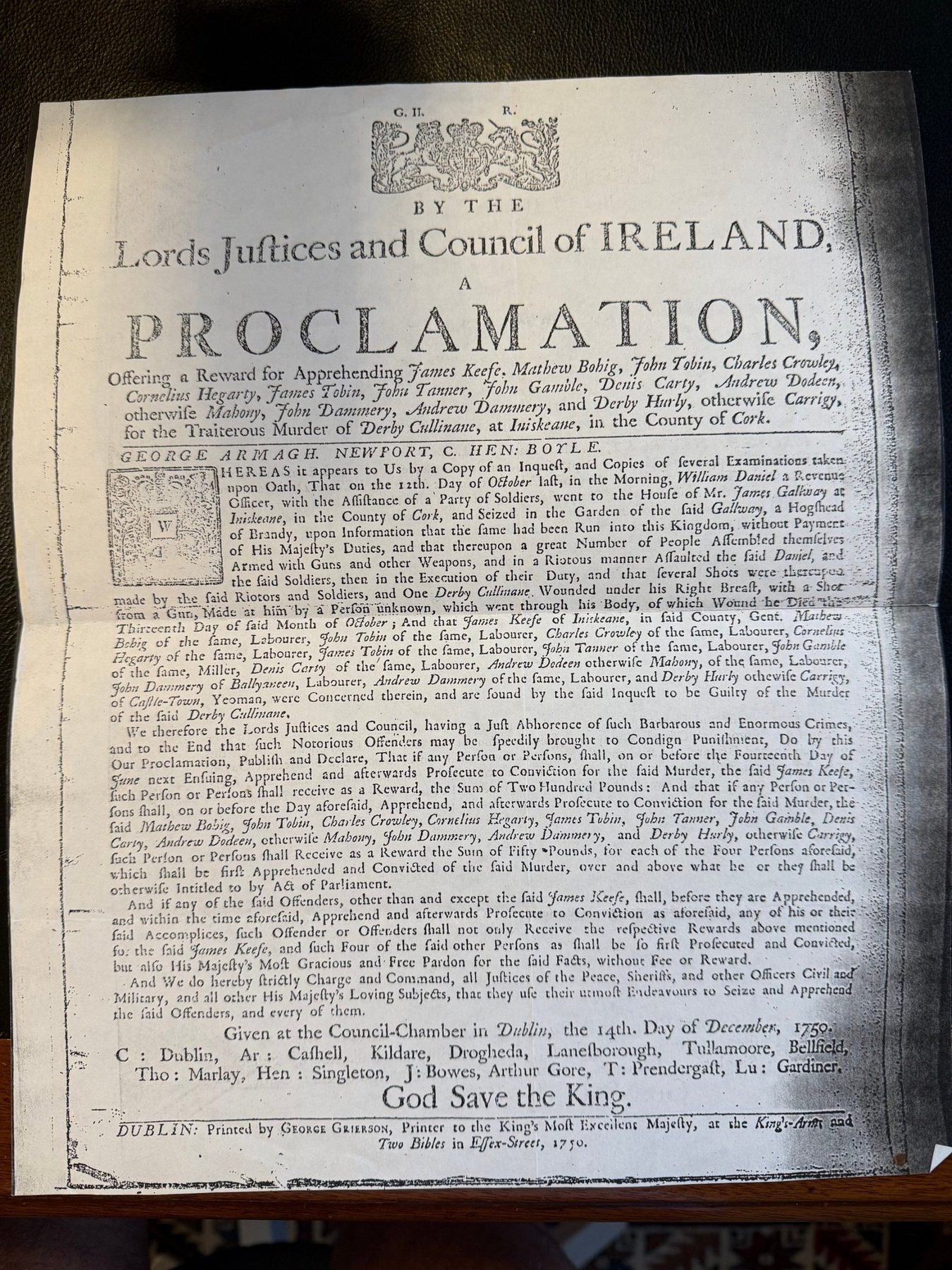
It began with brandy. On the morning of 12 October 1750 William Daniel, a revenue officer, went with a party of soldiers to the house of Mr James Gallway at Enniskeane and seized, in Gallway's garden, a hogshead of brandy that had been run into the kingdom without the King's duties paid. A great number of people then assembled, armed with guns and other weapons, and assaulted Daniel and the soldiers. Several shots were fired, the proclamation says, "by the said Riotors and Soldiers", and Derby Cullinane was wounded under his right breast by a shot from a gun "made at him by a Person unknown". He died the next day.
An inquest found thirteen men "concerned therein" and guilty of the murder, and on 14 December the Lords Justices and Council in Dublin offered rewards for them: two hundred pounds for James Keefe of Enniskeane, gentleman, and fifty pounds apiece for the first four of the others to be taken and convicted, with a free pardon for any of them who would give up the rest. The others were labourers of Enniskeane, a miller named John Gamble, a yeoman from Castletown, and, near the foot of the list, "John Dammery of Ballyaneen, Labourer, Andrew Dammery of the same, Labourer". The sheet was printed by George Grierson, the King's printer in Essex Street, and a copy of it is among the family papers.
For this family the sheet matters for another reason. The documented Damery line begins with Richard Damery of Ballymodan, whose children appear in the Bandon register from 1752, two years later; the Damerys of the following century farmed the ground around Ballineen; and there is no earlier record anywhere that names a Damery and a townland together. The first record of the family on its own ground is a wanted notice.
What became of the thirteen the proclamation does not say, and I have not found out. There is no record yet of an arrest, a trial or a pardon. John and Andrew have pages of their own in the family tree, among the unplaced Damerys: the Andrew of 1750 is an older man than the Andrew Damery who married Mary Twogood and was buried at Ballineen in 1814, and may be his father; neither link is entered in the tree, because neither is proven. The sheet also settles the spelling for that decade: the Council's clerks wrote Dammery, with two m's, the form the Melbourne branch kept.