Three roads to one baron
23 July 2026
The paternal legend names Roger d'Amory, dead in a rebellion in 1322. My father's grandmother's tree, built independently over three weeks, has now brushed against him three separate times, and one brush is proven: he married our documented cousin. The legend itself keeps its question mark. The pattern is recorded, and turned in the light.
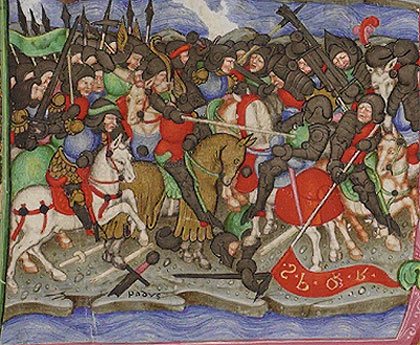
The oldest tradition in this family, the one at the head of the printed book, points the Damery name at Roger d'Amory: favourite of Edward II, Constable of Corfe, husband of a king's granddaughter, dead in Thomas of Lancaster's revolt in 1322. That tradition has been graded an honest question mark since this research began, and nothing below changes the grade. What has changed is stranger.
This week, while the de Vere ladder was being proven rung by rung, one of its lowest rungs turned out to be Alice de Clare, wife of the Master-Chamberlain slain in 1141, sister of the first Earl of Pembroke, daughter of Gilbert FitzRichard, Lord of Clare and Tunbridge. A documented direct ancestor of the house of Clare. And the house of Clare kept its habits for two more centuries, until its last great heiress, Elizabeth de Clare, the Lady of Clare, granddaughter of Edward I, sister of the earl killed at Bannockburn, foundress of Clare College, Cambridge, married, in 1317, one Roger d'Amory.
Sit with that a moment, as I had to. The man the family's name has always pointed at, on the paternal side, married into the very house the family's blood now documentedly runs, up the female line of my father's own family. Elizabeth is not an ancestor of ours; her branch of the Clares is the collateral one, and her only daughter carried Roger's line to the Bardolfs, not to Bandon. But the connection turns out to be exact. Elizabeth de Clare was the first cousin of my direct ancestress Margaret de Clare, the Leeds Castle woman; their fathers, Gilbert the Red Earl and Thomas of Thomond, were brothers, both sons of the same earl of Gloucester and Hertford. I descend from Margaret. So Roger d'Amory, the baron my paternal surname legend has always pointed at, married the first cousin of my documented ancestress Margaret de Clare: the husband of my ancestress's first cousin, one sibling away from the direct line, the closest a person can stand to your blood without being in it. Before this research he was a stranger the tradition reached for. He is now, provably, kin by marriage, at the nearest collateral point a man can occupy. The name legend is still unproven. The coincidence has gone from pleasant to almost eerie.
And it is the third such brush, each from an unconnected corner of the tree. The first is the name itself, carried to Cork by the paternal line nobody can yet trace past Bandon. The second has been sitting in the printed book's own appendix all along: the Ryves line bought Damory Court in Dorset, Roger's reputed seat, in 1548, and held it for two centuries. And now the third: his wife's house, our house. Three independent strands of one documented family, orbiting one obscure baron dead seven hundred years.
There is even a fourth wink, for those who enjoy the tree's sense of humour: Alice's brother Gilbert of Pembroke was Strongbow's father, and the FitzMaurice ladder on the other distaff flank stems from Strongbow's own invasion companions. The family's Irish and English halves have apparently been circling each other since 1170.
The rule stands as ever: none of this proves the paternal legend, and the site will not pretend it does. Coincidence is cheap in genealogy, and rare names attract it. But when three unrelated roads keep arriving at the same man, a family history is allowed to hold the pattern up, turn it in the light, and file it where the best unfinished business lives. The home page says it now without meaning to: from Drombeg, to Damory Court, to Domesday. All three words have blood on them; only the middle one is still waiting for its proof.