The Name and the Legend
Before the records of my own farming forebears begin, there is the name, and the name carries a thousand years of story. Much of it is tradition. All of it is mine to share.
The name and its many spellings
My surname has been written in a bewildering number of ways: Damery, Damory, D’Amory, D’Amery, Dammery, Damerie, Damry, and even Amery, Emery and Damer. In an age when clerks spelt by ear, these are all one Norman-origin name, from the place Daumeray in Maine-et-Loire (tangled up with the old personal name Amalric / Amaury, “exalted ruler”). It appears in Domesday Book as “de Dalmari.” The College of Arms treated these families as a single armigerous kindred, granting “the ancient Damory arms” to Gyles Damery in 1590 and to John Damerie in 1620. So this is one name, and the rarer a name was, the more a shared one meant. In the Middle Ages, people of the same surname were very often of one blood; it is only in our own crowded age that names scatter freely. That single fact runs underneath everything in this Part.
Even the Bandon registers that hold my own ancestors slide between spellings: the clerk wrote “William Damry” and “Richard Damry” in the 1720s, and “Damery” for a 1728 burial; the same family, the same hand, both forms. So in chasing the family back, I search Damery, Damry, Damary, Damyry, Damory, Dammery, Damerie, Amery, Amory, Emery and Damer all together.
The arms and the motto
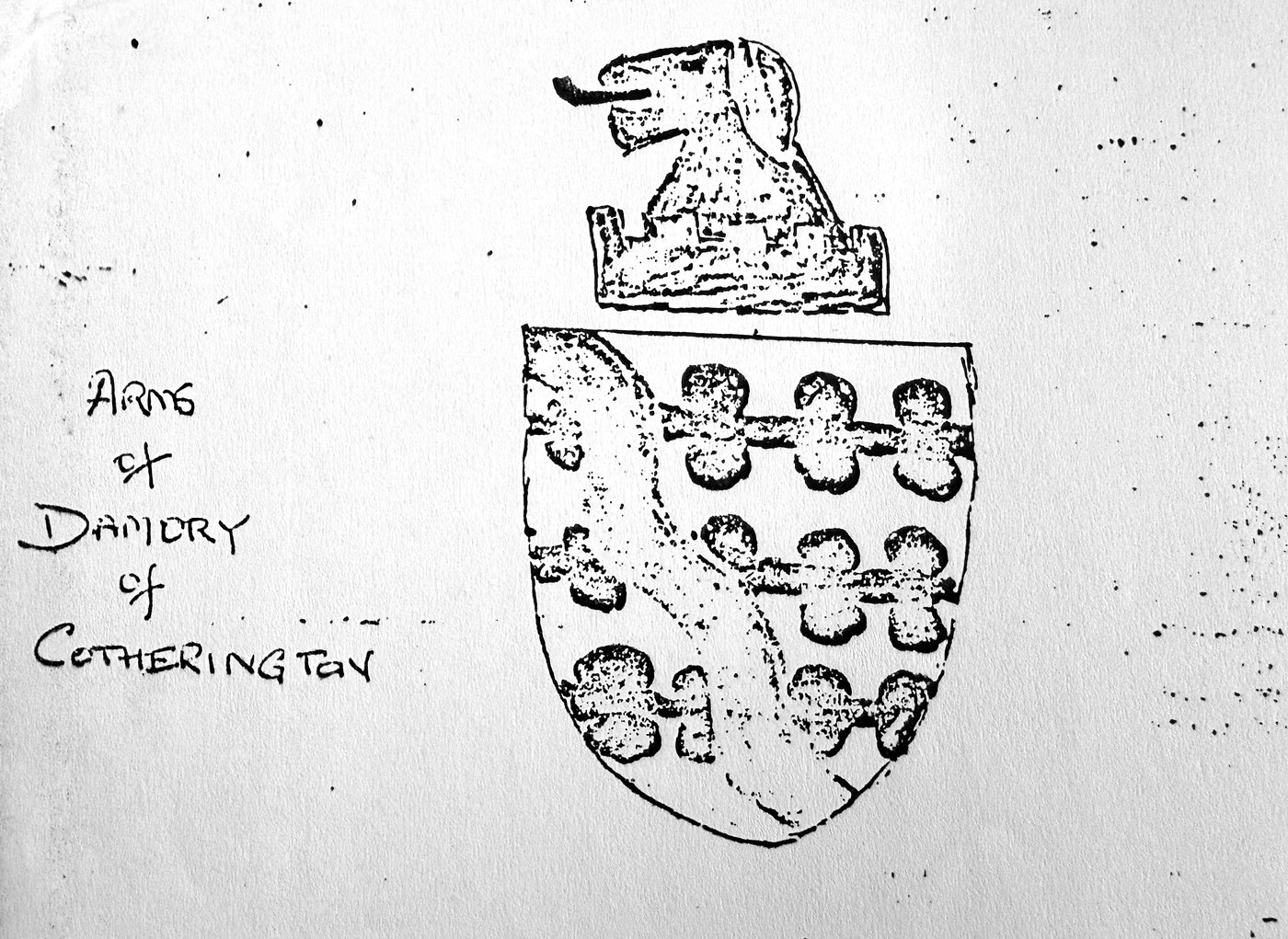
The ancient coat is barry nebuly of six, argent and gules (six wavy bars of silver and red), the younger line adding a bend azure for a second son; the crest is a talbot’s (hound’s) head. The medieval armorials record “Amory = Damory = Dammory” of Oxfordshire and Buckinghamshire bearing exactly these arms; a real heraldic thread linking the medieval barons, the Devon Amorys, the Gloucestershire Damorys, and the Cork family.
Two mottoes shadow this family. Tu ne cede malis (“Yield not to misfortunes”) with talbot supporters, belongs to the Damer Earls of Dorchester; and Allons en Avant (“Forward”) is the motto the College of Arms gave Edward J. B. Dammery of Melbourne when it granted him arms in modern times: real heraldic recognition of the family’s tradition.
But Tu ne cede malis is older than the Earls: Meredith's Descendants of Hugh Amory (1901) traces the motto and talbot crest to a 1592 grant to Gyles Damory of Cotherington, which Lord Milton only later assumed. The words on this book's cover, then, are a documented grant of 1592, to a Gloucestershire man of my own name.
And the Damers are not a separate name borrowed for a motto; the old Peerage of England (1790) traces their line, in the documented male line, straight up from the medieval d’Amories (below). The motto and the family are one.
The first Damerys of England: Sir Robert, Sir Richard and Roger
The earliest bearers of my name in England were no farmers but knights and barons. The Peerage of England of 1790 opens the family with William d’Amory, an attendant on William the Conqueror, seated in Dorset; then Gilbert d’Amory, with lands in Somerset under Henry II; then another Gilbert d’Amory, who served in the Gascon expedition under Edward I and left three sons. The family can be traced in the records back at least to 1138, and perhaps to Domesday itself. These are, so far as anyone can show, the first Damerys recorded in these islands, and given how rare the name was, they are in all likelihood the fountainhead from which every later Damery, mine included, springs.
Of Gilbert’s three sons, the famous one is Sir Roger d’Amory. A younger son and, in the chronicler’s phrase, “a poor and needy knight,” he fought with such distinction at Bannockburn (1314) that he caught the eye of King Edward II and rose to be the greatest of the royal favourites, Constable of Corfe, keeper of half a dozen castles, and by 1317 husband of Elizabeth de Clare, the King’s own niece and co-heiress to the vast earldom of Gloucester. For a country knight, it was a dizzying climb; it made him one of the richest men in England, with the lordship of Usk and lands in three counties. It ended as such climbs often did: when the Despensers displaced him, he rose in rebellion, and in 1322, sick or wounded, he was captured at Tutbury Castle, condemned to death, and died (illness beating the executioner by a day or two) before the sentence could be carried out. His arms still glow in the medieval glass of Tewkesbury Abbey.
But Roger left only a daughter, Elizabeth, who married Lord Bardolf, so no family descends from Roger himself in the male line. The name was instead carried on by his brothers, and this is the part that matters to me. His elder brother Sir Richard d’Amory was the steadier man and, in the early years, the more important: keeper of the peace in Oxfordshire, sheriff of Berkshire and Oxford, constable of Oxford Castle, Steward of the Household to King Edward II, and guardian of the body of the young prince who became Edward III. From Sir Richard, the documented male line runs on through his son Richard (d. 1375), and down, name and arms intact, to John d’Amory of Godmanston in Dorset and the Damer Earls of Dorchester. And there is a Dorset house that carries the name still: Damory Court at Blandford, by old tradition Sir Roger's own seat, into which, by a turn I keep for Chapter 8, the Freke–Swayne line of my grandmother's people would one day marry.
Nor were these two brothers the whole of the family. The records of the 1310s and 1320s are thick with Damory men; Sir Nicholas Damory, who became the most trusted of all Elizabeth de Clare’s officials, and three Damory scholars (Nicholas, Richard and William) at the new King’s Hall in Cambridge by 1318. The name threw off many branches; Roger’s want of a son was the exception, not the rule. My own Cork branch is not yet joined to that tree by a surviving record, but it is the same rare name, the same arms, and these are its earliest and noblest bearers. I set it down as family tradition: most probably the well from which my own line sprang.
And there is one last detail I cannot read without a smile. Sir Richard's wife was a Margaret; the Buckinghamshire records grant them Westbury Manor at Marsh Gibbon in 1313 to "Richard Damory and Margaret his wife," and Margaret held it as his widow until at least 1346. Three and a half centuries later, my own documented family opens in the Bandon registers with Richard and Margaret Damery. The same two names, at the very top of the family and at its humble foot. A coincidence, surely, but a haunting one to end on.
The 1790 Peerage adds a detail the modern accounts leave out: that Roger d’Amory had a second daughter, Eleanor, who married John de Raleigh, “from whom descended the great Sir Walter Raleigh.” The pedigree is old, and not everyone allows that Roger had a second daughter, so take it lightly. But it is a lovely turn if true: for my own Lucas of Youghal (Chapter 4) came to Ireland, by tradition, in Raleigh’s train. So the man who planted my Youghal ancestors may himself have carried d’Amory blood.
The d'Amory inheritance reached into Suffolk, for Roger's wife, Elizabeth de Clare, was the Lady of Clare, and Clare, the seat of that great family, is itself a Suffolk town, a few miles from Lawshall and Hartest, where my own yeomen would one day farm. And a Damery is found holding land right there: Sir Nicholas Dammory, Elizabeth de Clare's kinsman and one of the executors of her will, was lord of the manor of Depden, west of Bury St Edmunds, which he held by his marriage to Joan Wauncy, of the family long seated there. At Depden, he made his own will in February 1381, asking to be buried in the parish church. So three centuries before the Channells and Wrights of this book, a Damery already held a manor, and lies buried, a short ride from their fields. A coincidence, surely, rather than a bloodline; but an interesting one for a family story that runs from Drombeg to Bury St Edmunds.
The deep tradition: France, Frisia and Burgundy
Behind the English barons lies a still older inheritance of legend, gathered by Edward Damery of Melbourne (whose 1979 history underlies this book), set down again by Norman Damery of Cork, and enriched by the French Damerys (Paul Damery of Caen, whose father worked the French archives, and Charles Damery of Paris). It reaches back nearly forty generations, and it is to be enjoyed for the grand thing it is.
The French Damerys trace their name to Frankish roots, reaching back to Clovis, the first king of a united France. They point to the little town of Damery on the Marne, east of Paris in old Champagne, and to the Duchy of Bar close by; and Charles Damery of Paris recorded a Baron Damery of the Burgundian Netherlands, whose grave, dated 1350, he had seen in a churchyard at Damry just over the Belgian border, beside the ruins of a castle. From the Dukes of Burgundy and from Charles the Bold, the French branch claimed descent. Whether the family gave its name to Damery-on-the-Marne or took it from there, no one can now say; the towns, the duchy, and the grave are real, the descent a tradition.
The English chapter of the legend opens with Roger of Salisbury, said to have come over as chaplain to Henry I and risen to be the King’s chief minister and Bishop of Salisbury, so that “for two or three reigns the family were the financial heads of the kingdom of England.” The history then settles the family around 1200 as Robert d’Amory, with estates in Oxfordshire, the same county where the documented barons above appear a century later.
At its furthest reach, the tradition runs from a “Dammritter”, a “knight of the dykes”, in eighth-century Frisia, through a count at the court of Charlemagne, into the Norman settlement. It is a magnificent inheritance. One honest note, no more: a chain of forty generations cannot be checked link by link at this distance, and the medieval barons themselves descend, as we saw, through Roger’s brother, not Roger. Enjoy it as the family’s long memory of itself, which is exactly what it is.
When and Where the family crossed to Cork: The English West Country
Nearer home, two questions remain: which English branch crossed to Cork, and when. On the where, the evidence all points to the West Country, and to one armigerous kindred spread across three counties. Edward Damery recorded the tradition that the roots lay "in Devonshire, but under the name of Amory and Emery," and there is real support for it: at Whitechapel in Bishops Nympton, North Devon, a documented Amory / Damerie family "of Chappell" held the manor from the 1520s to about 1670, bearing the identical arms down to the second son's bend, their line ending in two heiresses, one of whom, Frances Amory, carried the manor to an Edward Gibbon, of the family of the great historian.
Meredith's book puts flesh on that Devon tradition, and, refreshingly, refuses to gild it. She prints the will of George Amorie of Bishop's Nympton, yeoman, proved in 1598, naming his sons John, Anthony and William; and from the same register she notes a Richard, son of Anthony Amory, dying in 1571. These are not gentry but yeomen, and they already carry, three generations before Bandon, the very forenames that run down my own line: Richard, John, William. She is careful to show that the grand "Damory" pedigree the Earls' heralds afterwards drew up was stitched onto this plain Amory stock to dignify it "in no record," she remarks, was their Rector of Aisholt truly Damory, but Amerie. I take the point gladly. If my family did step out of the West Country, it was likelier out of a yeoman Amory household of Bishop's Nympton than down from any coronet and the names, at least, kept faith across the sea.
But interestingly, my family kept the "D-" spelling, Damery and Dammery; and that spelling belongs less to Devon, which had become Amory and Emery, than to Gloucestershire, where the armigerous Damory of Yate and Cotherington bore the very same coat, confirmed to Gyles Damory of Cotherington by Clarenceux in 1592, and where a whole Dimery family farmed at Thornbury through the 1600s.
There is even a third corner, Dorset, the county of the Damer Earls: at Frampton, a Richard Damer "alias Blandamore," son of a William, was baptised in 1650 into a family of Dorchester tradesmen; once the closest fit on paper, though the family's wills, since read in full, name no Richard who could have crossed, and the fit has faded.
The honest answer is the West Country as a whole (Devon, Gloucestershire and Dorset), branches of one arms-bearing kindred, and that is exactly the prize still being chased.
On the when, there is no proven date, only a set of open doors. The earliest is the Elizabethan plantation of Munster in the 1580s and '90s, when English settlers were planted on confiscated land west of Bandon (the Beamish among them). No Damery is yet documented in Cork so early, but the country registers barely begin before the 1600s, so an early crossing can neither be shown nor ruled out. Then came the walled Protestant town of Bandon itself, settled from about 1612 to 1620 by English and Welsh Protestants, many "from Taunton and Kingston in Somerset”, a cloth-weaving town, fitting ground for a Damery clothier. Then the Cromwellian settlement of the 1650s, when Protestant "Adventurers for Land" took up forfeited estates.
And then the door the family's own tradition leans against: the Monmouth Rebellion of 1685. The West Country my Damerys came from was Monmouth's country; when the Duke raised his Protestant standard at Taunton, his foot were the very people of these towns, the serge-weavers and woolcombers of Tiverton, Honiton and Cullompton. After their slaughter at Sedgemoor, and the hangings and transportations of Judge Jeffreys's "Bloody Assizes," the survivors scattered, and the family's tradition is precisely of a flight from England in the reign of James II. Whether a Damery fled Monmouth's wreck for the Protestant refuge of West Cork I cannot prove; my documented family appears at Bandon only in the 1690s, but the timing, the place and the trade all rhyme, and it is the most stirring of the open doors. And in the summer of 2026 that door creaked open. In the printed Bristol servant registers, ten days after Sedgemoor, stands Richard Dymery of Dursley, Gloucestershire, broadweaver, who indentured himself on 16 July 1685 for four years' service in Jamaica. The right name, the right trade, the right county, signing himself out of England in the very weeks the tradition requires, while the Jamaica ship Samuel & Mary loaded in the harbour. He is the one member of the Gloucestershire Dimery clan whom the English records release and never mention again. Whether he served his term, or slipped ashore when the ship victualled at Cork, and whether he is the Richard who buried Margaret at Bandon eleven years later, is now the leading working hypothesis of the whole search. Probable enough to chase hard, not yet proven, and flagged so.
No record yet ties a particular Bandon Damery to a particular English family. The English crossing, Devon, Dorset, Gloucestershire, or all three, is the family’s one great open question, and the prize is still worth chasing. A separate research brief sets out the leads.
This essay was printed as the family's deep tradition, graded an honest question mark throughout, and the grade has not moved. But July 2026 changed the ground it stands on, twice, and readers deserve to know it before they leave this page. First: the family now HAS documented lines, two of them, to the Conquest's own generation. Neither runs through the Damery name: one climbs the female lines of my father's grandmother through Jane Vere of Gosfield to the de Vere Earls of Oxford, proven three times over (Chapter 22); the other, through Alice de Clare to Richard FitzGilbert de Clare, Domesday tenant-in-chief and joint Justiciar of England, on whose 1086 standing no caution sits at all (Chapter 23). Second: Elizabeth de Clare, the great heiress this essay leaves on Roger d'Amory's arm, turns out to be family twice over: my documented blood cousin, and now, by the Raleigh road proven in August, the sister of my direct ancestress Eleanor de Clare. Which means the baron at the centre of this essay's tradition is no longer a stranger the family reaches for: he is the husband of an ancestress's sister, kin by marriage at one remove, his first documented place in this family in seven centuries of telling. The pattern, and what it does and does not prove, is turned in the light in the Journal. The essay below stands as printed, and its question mark stands with it. The question just got better company.
Two things in the essay below have since been tested and failed, and are corrected here rather than rewritten. The male line "name and arms intact" from the d'Amory barons to the Damer Earls of Dorchester is the Peerage's pedigree and not the record's: the barons' line ended without heir in 1375, and the Damer descent was manufactured for Lord Milton in the 1760s and taken apart by Meredith in 1901; the motto Tu ne cede malis was the Damers' own, and this family assumed it knowing that. And the Richard Dymery of Dursley indentured at Bristol in July 1685, "once the closest fit on paper", has not yet been found in the full Bristol servant registers for 1654 to 1686, which were read for every spelling of the name in October 2026; the original entry is on the list to be read again before the hypothesis carries any weight. The whole English question, with the Devon door now closed and Essex opened, is worked to the record in Damery before Cork.