The Clares: the second anchor
The de Vere ladder reaches Domesday with one honest asterisk. The Clare ladder, wired a day later, reaches it with none: Richard FitzGilbert de Clare, companion-in-fortune of the Conqueror, and Rohese Giffard beside him.
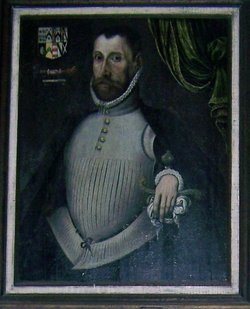
Chapter 22 ended at the edge of Domesday Book with Cokayne's caution posted on the last rung: one Aubrey, or possibly two, or three. This chapter removes the asterisk, by another road entirely. Alice de Clare, wife of the Master-Chamberlain slain in 1141 and a documented direct ancestor on the Vere ladder, was the daughter of Gilbert FitzRichard, Lord of Clare and Tunbridge; and Gilbert's father is not a man the records hesitate over. Richard FitzGilbert de Clare, called also de Bienfaite and de Tonbridge, founder of the house of Clare in England, came over with William the Conqueror and was among the greatest beneficiaries of the Conquest: Domesday tenant-in-chief in 1086 of some one hundred and seventy lordships centred on Clare in Suffolk and Tonbridge in Kent, and joint Justiciar of England in 1075, governing the kingdom in the King's absence. On his Domesday standing no caution sits at all. The one thing tradition claims for him that the records do not prove is his personal presence on the field at Hastings, and it is kept as what it is: tradition, graded, cherished.
His wife earns her own paragraph, and not as decoration. Rohese Giffard is documented in her own right, charters, benefactions, a recorded widowhood, so Gilbert's parentage stands complete on both sides, which at this depth is rarer than it sounds; most eleventh-century wives survive as blanks. Her father, Walter Giffard, lord of Longueville, was himself a Domesday magnate, and something more: he is one of the handful of men whose presence at Hastings on 14 October 1066 is attested by contemporary sources, William of Poitiers naming him in the battle itself. Savour the irony the grading produces: mighty Richard's presence on the field is only tradition, and the Vere rung carries Cokayne's caution, but one note-only step behind Rohese stands a proven combatant of Hastings. The family may now say "we descend from a man who fought at Hastings" without an asterisk: the road runs through her, and the wire went in the same week, at the author's word. Behind Richard, the printed pedigrees run one step further still, to the ducal house of Normandy, across a step the heralds flag as illegitimate; and for weeks this page said it was left unwired because this family's rule does not bend for dukes. The rule did not bend; the evidence caught up. Richard's grandfather Godfrey, Count of Eu, was a son of Duke Richard the Fearless, openly acknowledged, provided for and counted, the same standing this tree already accepts for Robert of Gloucester, and on that standing the step is now wired: the Clares reach Rollo by their own road.
The house they founded kept its habits. Their son Gilbert; his daughter Alice, who carried the Clare blood to the Veres and so, nine generations of paper later, to a Limerick wedding and a Cork kitchen table. Their other descendants are this family's most spectacular collaterals: Gilbert of Pembroke, whose son Strongbow took Leinster; the earls of Hertford and Gloucester; and at that line's end the three Clare sisters, one of whom, Eleanor, is now a proven ancestress by the Raleigh road, while another, Elizabeth, foundress of Clare College, Cambridge, made the 1317 marriage to Roger d'Amory that is the coincidence the Journal is still turning in the light.
So the tree now holds two Domesday anchors. The Vere one comes with the better story, a vineyard at Hedingham and a star fallen on a standard, and one honest step short. The Clare one comes with the better proof: a justiciar of England, one hundred and seventy lordships, and no asterisk. The home page's claim, from Drombeg to Damory Court to Domesday, now rests on the Clares, solid; the vineyard is demoted to what it always was, the better story beside the better proof. And the name at the top of this whole research, the Bandon founder's name that started everything, still waits on a register in Dublin, which is exactly the proportion of triumph to humility a family history should keep.