The princes of Wales and the kings of Ireland
Chapter 25 told two Irish crowns. Since then the Welsh princes have come in house by house, a road has been found from Wales into Viking Dublin, and the Irish kingships in the direct line have grown from two to five.
Chapter 25 had two Irish crowns in it, Leinster and Munster, and Wales was a single line in a list. Both are now much larger, and they turned out to be joined.
Three houses of Wales
Gwynedd came first. Gwladus Ddu, who married Ralph Mortimer, was a daughter of Llywelyn the Great, and behind him the line runs through Owain Gwynedd and Gruffudd ap Cynan to Rhodri Mawr's sons. Her mother is in the tree too: Joan, the acknowledged natural daughter of King John.
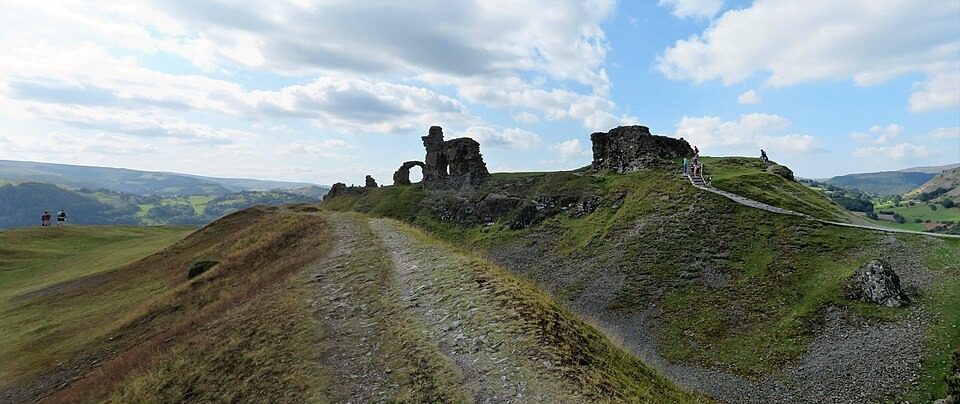
Powys followed. Owain Glyndŵr, the last Welshman to be called Prince of Wales, is an ancestor through his daughter Alys, who married Sir John Scudamore of Kentchurch. His father's line was then entered back through the lords of Glyndyfrdwy and Dinas Brân to Madog ap Maredudd, the last king of all Powys, and to Bleddyn ap Cynfyn, who died in 1075.
Deheubarth, the kingdom of the south, was already here through Nest, daughter of Rhys ap Tewdwr. Then her brother's line joined it: the Lord Rhys, who held the first recorded eisteddfod at Cardigan in 1176, and his mother Gwenllian, who led an army against the Normans at Kidwelly in 1136 and was killed there. Gwenllian was a daughter of Gruffudd ap Cynan of Gwynedd, so the houses of north and south meet in her.
With them came Gruffydd ap Llywelyn, who died in 1063, the only man ever to rule the whole of Wales. And at the battle of Mynydd Carn in 1081, which decided who would hold Gwynedd and Deheubarth, the two victors and the king they killed are all three ancestors.
The road through Dublin
Gruffudd ap Cynan was born in Dublin. His father was an exiled prince of Gwynedd and his mother, Ragnaillt, was a granddaughter of Sitric Silkbeard, the Norse King of Dublin who fought Brian Boru at Clontarf, struck the first coins in Ireland and founded Christ Church.
That one marriage brought in two Norse crowns. Sitric's father Olaf Cuarán was King of Dublin for thirty years and twice King of York, and died a monk on Iona in 981. Olaf's father, Sitric Cáech, held both kingdoms before him.
It also opened a second way into Ireland. Sitric Silkbeard's mother was Gormlaith, daughter of Murchad mac Finn, King of Leinster. Until then every Irish royal descent in the tree ran through Constantia Piers. Leinster now has a road that does not. The link through Ragnaillt rests on one medieval source, the Life of Gruffudd ap Cynan, written within about twenty years of his death.
The same road comes within one step of Brian Boru. Sitric's wife was Brian's daughter Sláine. That she was the mother of the son through whom the line runs is probable and no more, so I have not counted it.
Leinster
Leinster now has three royal houses in the line.
The oldest is the Uí Dúnlainge of Naas. Their pedigree has since been rebuilt from the annals, and gained three generations. It ends with Dúnlaing mac Énda Niada, forty-seven generations back, the furthest ancestor in the tree. The Tripartite Life of St Patrick has the saint baptising Dúnlaing's two sons at a well outside the fort of Naas.
The second is the Uí Cheinnselaig, the house of Diarmait Mac Murchada. His line is now entered back to Diarmait mac Máel na mBó, who took the kingship of Leinster, sheltered the sons of Harold after Hastings, and was killed in 1072.
The third is the O'Conor Faly, kings of Uí Failghe in the midlands, who held out until the Tudors made their country King's County.
The Kavanagh kings are here as well, down to Donal Reagh, who died in 1476. He is the last king of any country in the direct line, and his daughter Sabh married a Butler. The Kavanaghs are said to descend from Diarmait Mac Murchada. That join is tradition, and it is not entered.
Osraige, Desmond and Connacht
Osraige lay between Leinster and Munster and answered to neither. Its king Cerball mac Dúnlainge, who died in 888, is the Kjarvalr of the Icelandic sagas. His great-grandson Gilla Pátraic gave his name to the FitzPatricks, and Gilla Pátraic's daughter Aífe carried the blood into Leinster.
In Munster the O'Briens of Chapter 25 were joined by their rivals. The MacCarthys kept Desmond, the southern half, when the province was divided in 1118. Cormac Mac Carthaigh built the chapel that bears his name on the Rock of Cashel. A younger branch, the MacCarthy Reagh, became lords of Carbery, the barony in which Drombeg stands.
Connacht was the last. Mór, wife of Diarmait Ua Briain, was a daughter of Ruaidrí na Saide Buide, King of Connacht, who was blinded by a rival in 1092. Behind him are eleven kings of the province in fourteen generations, back to Muiredach Muillethan, who died in 702.
The count
Five Irish kingships now stand in the direct line: Leinster, Munster, Osraige, Desmond and Connacht, with the Norse kingdom of Dublin beside them. Brian Boru, reached by one road when Chapter 25 was written, is reached by six. All six still pass through Constantia Piers and the will of 1707.