The will that proved the gate
After the last doors closed I went back and tested what was already in the tree. One royal descent in the printed pedigrees broke. Another, to Edward I, was proved in its place. And the one link that every Irish crown depends on was found in a will that survived the fire of 1922.
The last chapter ended with no doors left to open before 1500. What came next was different work. I went back over the links the tree already had, to see which stood on a record and which stood only on a printed pedigree.
A bridge and a diarist
The first gain was a bridge that had been missing for years. William Kingsmill of Ballybeg in County Cork, who died in 1650, is on my father's grandmother's side. Burke's Landed Gentry of Ireland joins him to his father, Sir Francis Kingsmill, one of Carew's officers in the Nine Years War, and to the Kingsmills of Sydmonton in Hampshire.
It brought an unexpected cousin. Sir Francis's daughter Dorothea was the mother of Elizabeth St Michel, who married Samuel Pepys. The wife in the diary was first cousin to my ancestress Lavinia Kingsmill. I checked that against the will of Thomas Kingsmill, made in 1702, which names his own children and no Lavinia. She was William of Ballybeg's daughter, as Burke says.
The door that broke
William Kingsmill of Ballybeg married Dorothy St Leger, and the printed pedigrees carry the St Legers up through Ursula Neville to Edward III. It would have been the first road to that king.
It does not hold. Lodge, Burke and the pedigrees that copy them have merged two men called Sir Warham St Leger, an uncle and a nephew. Ursula Neville was the uncle's wife, and she died in 1575. Dorothy was alive a hundred years later, in 1675. She was a daughter of the nephew, who was killed fighting Hugh Maguire outside Cork in 1600, and of his wife Elizabeth Rothe of Kilkenny. The mistake was shown in print in 1896.
I took the Neville descent out. What is left is still worth having: Dorothy's great-grandfather was Sir Anthony St Leger, Lord Deputy of Ireland under Henry VIII, and his wife Agnes Warham was a niece of the Archbishop of Canterbury.
The door that held
Sir William Kingsmill of Sydmonton married Bridget Raleigh, and her family offered a second chance. This one I tested link by link before entering any of it.
Bridget's great-grandfather, Sir Edward Raleigh, made his will in 1509, and it fixes two generations of the family and the families they married into. From there the line runs through the Greenes of Greens Norton and the Ferrers of Chartley to Margaret le Despenser, and so to Hugh Despenser the younger and his wife Eleanor de Clare. Eleanor's mother was Joan of Acre, daughter of Edward I.
Chapter 24 reached Edward I through his daughter Elizabeth and the Butlers of Ormond. Now a second daughter of the king was in the direct line, by a road that owes nothing to the first. A third suggestion, through the Giffords and the Paulets, I tested at the same time. It failed, and it is not in the tree.
The gate
All of this was on the English side. The Irish crowns had a weakness of their own, and I had known about it from the start.
Every road this family has to Brian Boru, to William the Lion of Scotland and to the Kavanagh kings of Leinster passes through one woman: Constantia Piers, who married the Reverend Vere Hunt in 1712. The royal blood is her mother's, Honora FitzMaurice, Lady Piers. That Constantia was Honora's daughter rested on Burke and nothing else. If it was wrong, three kingdoms went with it.
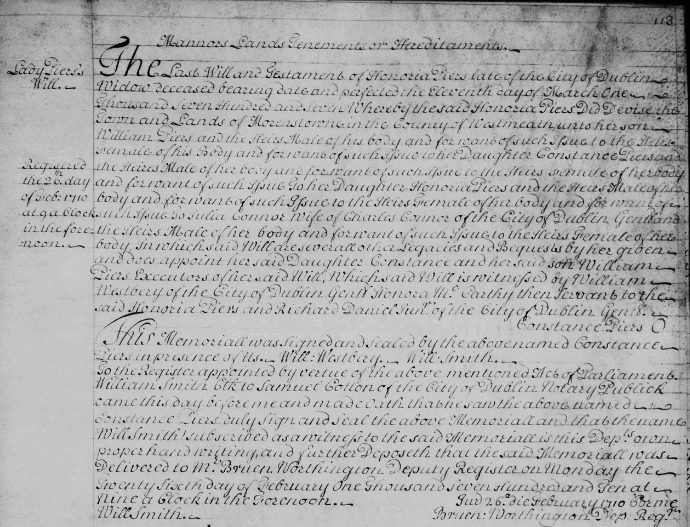
The proof should not exist. Honora's will was among the records burned at the Four Courts in June 1922. But from 1708 a will could also be registered at the Registry of Deeds in Henrietta Street, and the Registry did not burn. I found it there: the will of Honoria Piers of Dublin, widow, made on 11 March 1707/8 and registered in February 1710/11.
She leaves her Westmeath lands to her son William, and after him to "her Daughter Constance Piers". She names Constance an executor. At the foot of the memorial is Constance's own seal.
A second memorial in the same volume, made in the same fortnight before the same two witnesses, has "Constance Piers of the City of Dublin Spinster" lending two hundred pounds on land in County Louth. It is the same woman, the year before her marriage.
Where it stood
At that point the tree held 1,471 direct ancestors. I went through every one of them and counted how many still carried a question mark. There were seven, and they were the seven I already knew: among them the father of Richard Damery of Ballymodan, the earliest Brady, and the Jones who is said to have come to Bandon with Cromwell.
The will has mattered more as the tree has grown. Six roads now lead to Brian Boru, and the kings of Connacht have joined them. All of them still pass through Constantia Piers.