Baptised by Patrick
8 November 2026
The Tripartite Life of Saint Patrick puts the saint at Naas, baptising Ailill and Illann, sons of Dúnlaing, at the well north of their father's fort. The annals put the same two brothers on a battlefield in Carlow in 490. Three independent sources now agree on the family's oldest generation, and one of those two men is my forty-two times great-grandfather.
There is a well in a grove of elder trees at Oldtown, on the northern edge of Naas, just inside an old demesne wall. People in the town have called it St Patrick's Well for as long as anyone has written the name down. Until this week I had no reason to give it a thought.
The week was meant to be routine. The oldest generations of this tree belong to the Uí Dúnlainge of Naas, the dynasty that would later dominate the kingship of Leinster, and I have always graded them cautiously. I went back over the early sources to check those grades. Most stayed where they were. The fifth-century men stand, and so do the father-to-son links between them. The royal titles attached to the earliest of them I have marked down a step, because king-lists compiled centuries later are better evidence for who was related to whom than for who wore a crown.
Then, reading the Tripartite Life for something else, I came to the passage on Naas.
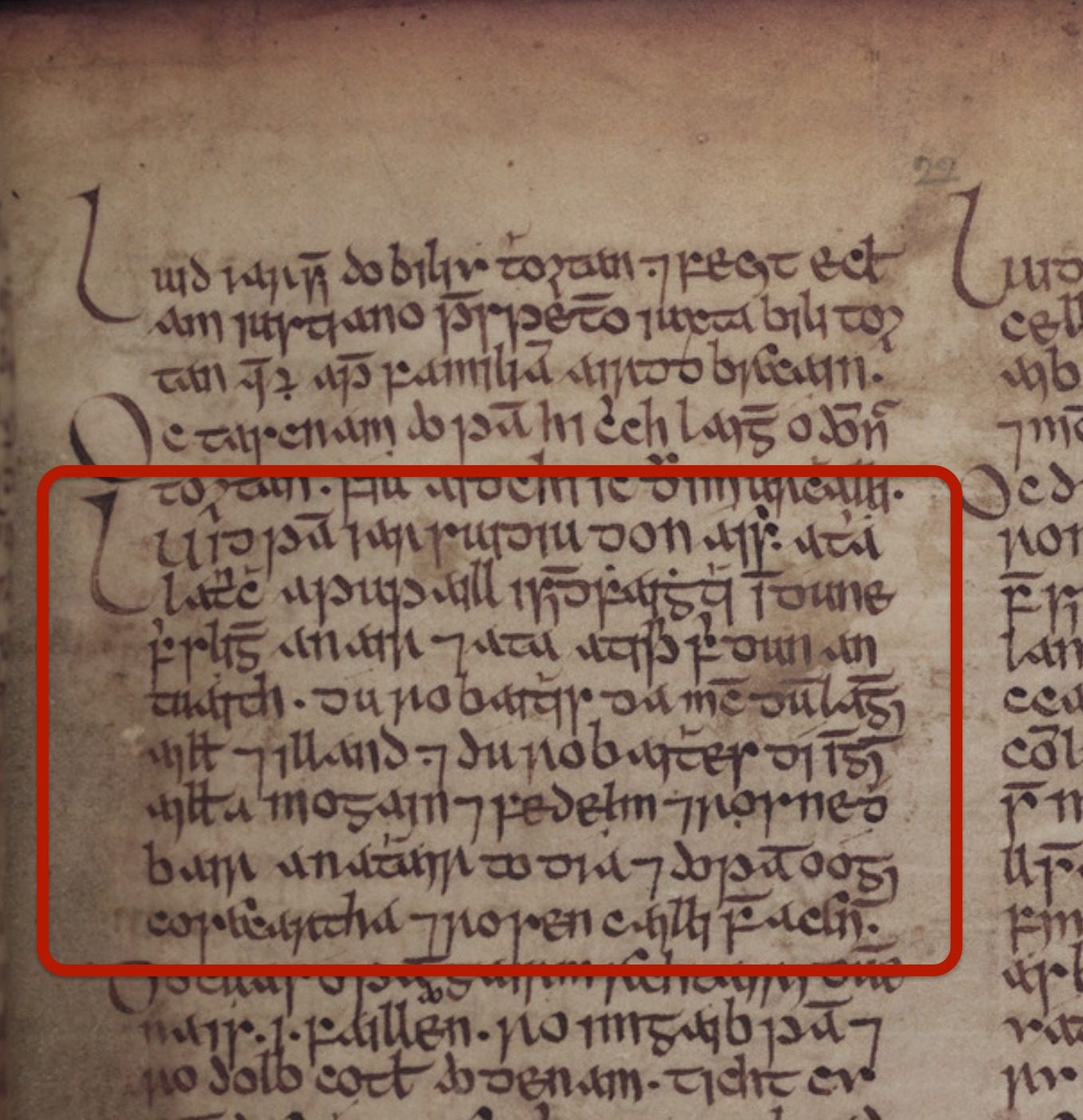
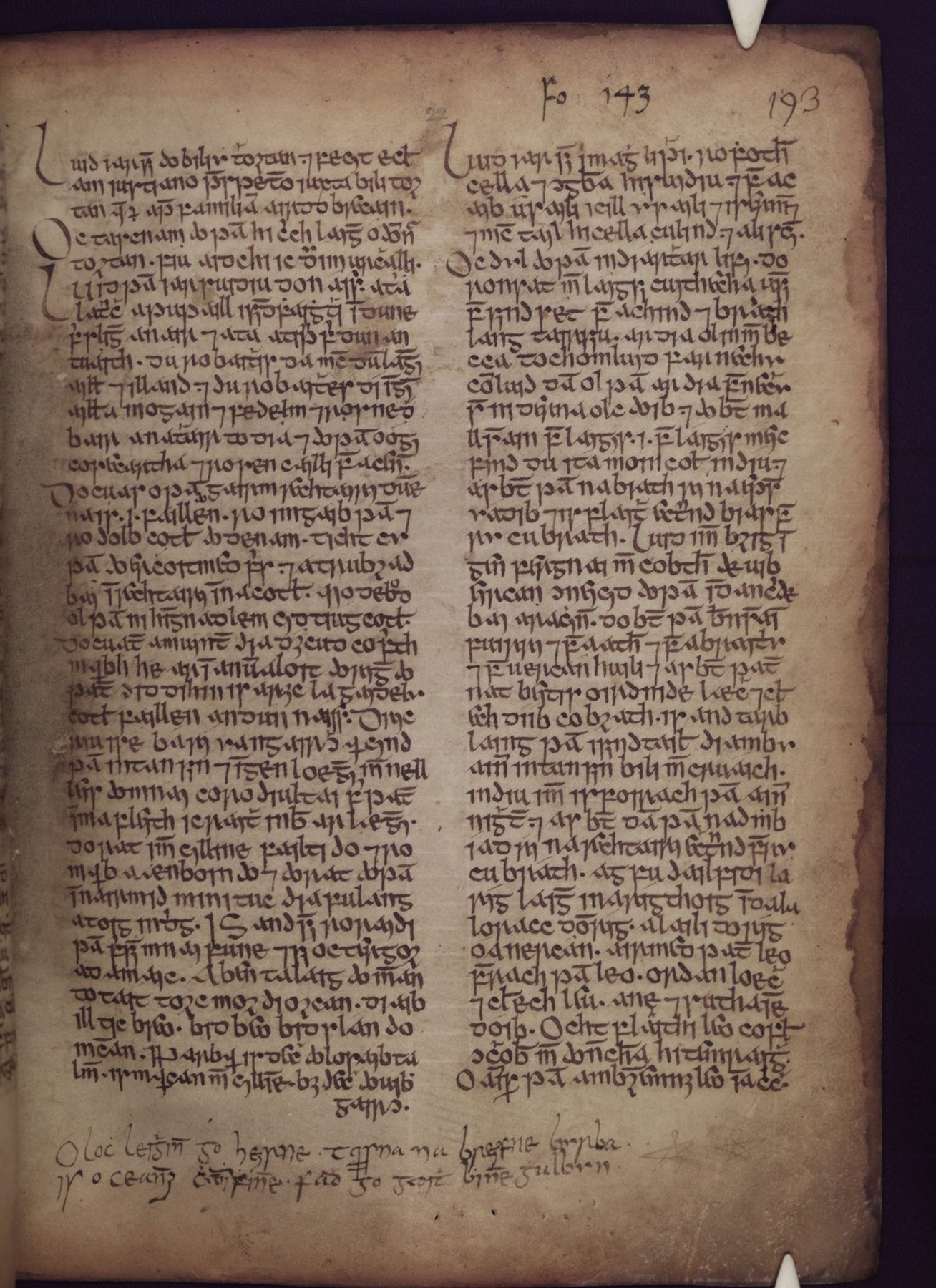
The Life was compiled around the 890s from an older collection of Patrick traditions. The copy pictured above is a fifteenth-century manuscript now in the Bodleian Library, Rawlinson B 512. Here is the passage in full:
Luid Pátraic iar suidiu don Nás. Atá láthrach a pupall isin faithchi in dúine fri sligid anair, ⁊ atá a thipra fri dún antuaid, du ro baitsed dá mac Dúnlaing, Ailill ⁊ Illand, ⁊ du ro baitsed dí ingin Ailella, Mogain ⁊ Fedelm, ⁊ ros-n-edbair a n-athair do Dia ⁊ do Pátraic, óga coisrectha, ⁊ ro sen caille for a cenn.
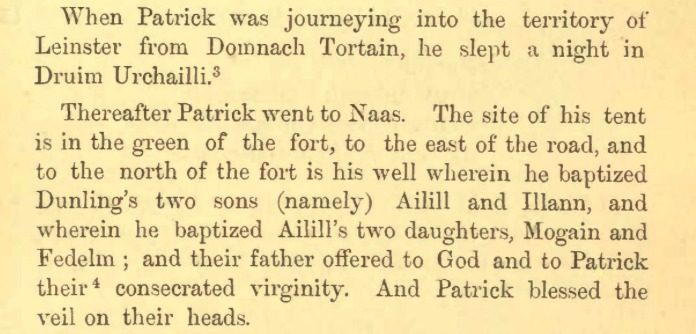
After that Patrick went to Naas. The site of his tent is on the green of the fort, east of the road, and his well is north of the fort. There he baptised the two sons of Dúnlaing, Ailill and Illann, and there he baptised the two daughters of Ailill, Mugain and Fedelm. Their father offered their consecrated virginity to God and to Patrick, and Patrick blessed the veils upon their heads.
(The Irish follows Whitley Stokes's edition of 1887, lightly normalised; the manuscript's own spellings are on the page above.)
Ailill son of Dúnlaing is our ancestor: the generation between the founder of the dynasty and everyone who came after him.
What struck me first was how exactly the passage describes the ground. A tent on the green. A road. A well on a named side of the fort. In 1892 Archdeacon de Burgh of Naas took the Kildare Archaeological Society over the ground. The fort, he said, is the North Moat, the great mound that still stands in the middle of the town; the road is Main Street; the green is the old Fair Green; and St David's Church stands where the tent stood. In 1905 Archbishop John Healy placed the well just inside the demesne wall on the road in from Clane, and noted that the woman at the gate lodge would take any visitor down to it. Both men were working from the Life, fourteen centuries after Patrick. The mound is still there, and so is the well, and you could visit both in an afternoon.
The Life was set down about four hundred years after Patrick, and nothing nearer his time survives to check it against. By then the Uí Dúnlainge had held the kingship of Leinster for a century and a half, and a Life that has the saint baptise the founder's sons at the family's own fort served the church and the dynasty alike. What the passage records is the tradition as the ninth century held it.
It is also a second, separate witness to the family. The genealogies and king-lists say Dúnlaing had sons called Ailill and Illann, based at Naas. The Patrick tradition was kept by different people, written down by the ninth century for different reasons, and liable to go wrong in different ways. It names the same father, the same two sons and the same fort.
The annals are the third witness, and the plainest. Under the year 490 the Annals of Ulster record the battle of Cenn Losnada in Mag Fea, in what is now County Carlow, where Óengus mac Nad Froích, king of Munster, was defeated and killed. Most fifth-century entries are brief and were written up long afterwards. This one names its source, the lost Book of Cuanu, an early chronicle independent of the later monastic compilations. The Annals of Tigernach and the Four Masters name the victors: Illann and Ailill, sons of Dúnlaing, holding Leinster against Munster. The dates also hold together. A man fighting in 490 and dying, as the record has it, in the 520s had a normal working life, which is exactly the test that entries from this period usually fail.
So three sources with different keepers and different motives name the same two brothers at the same place: the genealogies as rulers, the Life as converts, the annals as soldiers in a dated year.
The men themselves are better attested than I had any right to expect.
The ninth century believed Ailill was baptised at that well, and wrote down the spot precisely enough that people in Naas were still pointing to it a thousand years later, his daughters remembered beside him with their veils. The line from him runs forty-eight graded generations down to a farmhouse in Cork, and it is drawn on the tree.