The long sword
1 November 2026
A fourth road to the Plantagenets, and the shortest kind: father to son. William Longespée, Earl of Salisbury, was Henry II's acknowledged natural son, and his granddaughter Ela is in the documented direct line.
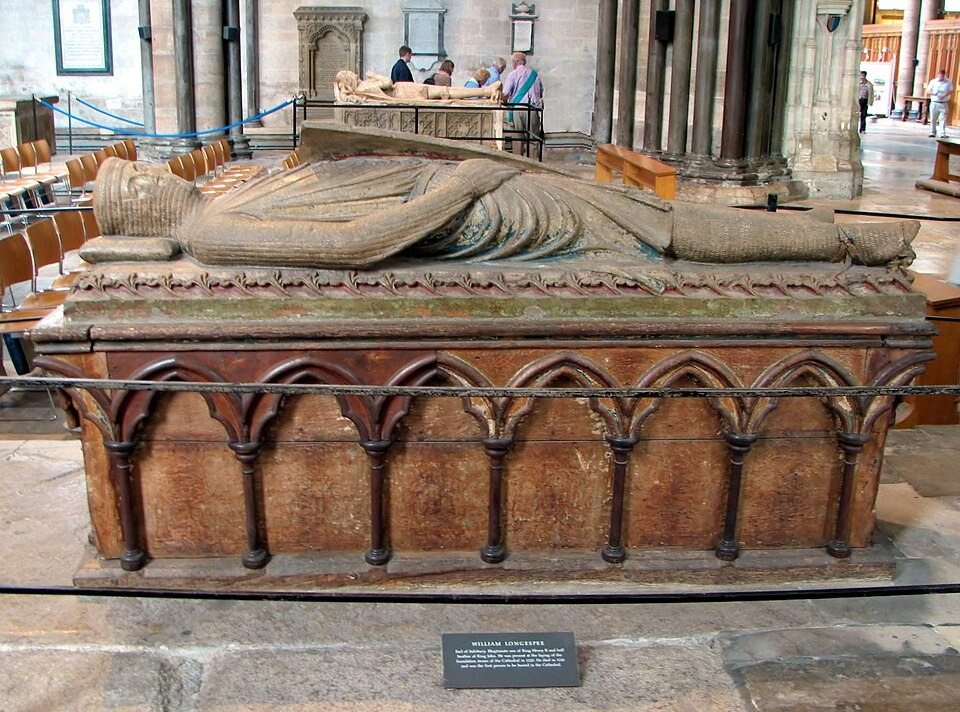
Henry II has been in this tree for months, reached through Edward I and the long ladders of the thirteenth century. The September research added a shorter road. William Longespée, "long sword", was Henry II's natural son, acknowledged and brought up at court. Richard I married him to Ela, Countess of Salisbury in her own right, and he became Earl of Salisbury through her. He stood by his half-brother King John through Magna Carta and the French invasion that followed, commanded the English fleet that destroyed the French ships at Damme in 1213, and was one of the first men buried in the new Salisbury Cathedral, where his painted effigy is still in the nave. His granddaughter Ela Longespée married into the Audleys, and from there the line comes down by roads already on the site to Margaret de Clare and the Raleighs.
For centuries the romancers made his mother Fair Rosamund, until a charter of William's own was found naming his mother as Countess Ida. She was Ida de Tosny, who after her time at Henry's court married Roger Bigod, Earl of Norfolk. Ida was already in this family's line as the mother of the Bigod countesses. She is now in it twice, by the King's son and by the Earl's daughter, the fifth woman found in the tree twice over.
The Longespée generations have their own stories in the notes. William's son, William II, died leading the charge at Mansurah in Egypt on crusade in 1250. The first Earl's widow, Ela, founded Lacock Abbey in 1232, became its abbess, and served as sheriff of Wiltshire in her own right. Henry II, the Empress Matilda and Geoffrey of Anjou are now reached by four separate documented roads. The roll is in The Royal Houses, and the rungs on the tree.