Sir Roger Damory and Elizabeth de Clare
A favourite of Edward II, the Lady of Clare, and their daughter.
By Aynsley Damery, November 2026 · Download as PDF (21 pages)
Summary
Roger Damory was a younger son of an Oxfordshire knightly family who rose, in the three years after Bannockburn, to be the most influential man at the court of Edward II. In 1317 the king married him to his own niece, Elizabeth de Clare, one of the three heiresses of the earldom of Gloucester, and summoned him to parliament as a baron. By the end of that year Thomas, earl of Lancaster, counted him his chief enemy among the royal favourites, and the king’s senior councillors had bound him by a formal indenture to restrain his influence over the king.
He left court after the Treaty of Leake in 1318 but kept the king’s favour until 1320, when the younger Hugh Despenser, married to Elizabeth’s eldest sister, began to take the Gloucester lands in Wales for himself. Damory joined the Marcher lords against Despenser in 1321, held Glamorgan, and was named in the charges that sent the Despensers into exile. When the king struck back, he went north with the earl of Hereford to join Lancaster. He was wounded at Burton-on-Trent in March 1322, taken at Tutbury, condemned as a traitor on 13 March, spared execution because the king had once loved him, and died within a day or two. He was buried in St Mary’s church, Ware.
Elizabeth was imprisoned at Barking with her children, stripped of her Welsh lands, and forced into agreements she set down in a secret protest in 1326. She outlived Roger by thirty-eight years, never remarried, founded Clare College, Cambridge, and for the rest of her life sealed her documents with Roger’s arms. Their surviving daughter, Elizabeth, married John Bardolf of Wormegay in 1327. The Bardolf line descends from her, and through it the Damery family of County Cork.
This paper brings together the record evidence and the modern historians on both of them. Where the sources disagree, the disagreement is set out and a reading given.
1. The Damorys of Bucknell
The Damorys were knights of Bucknell in Oxfordshire, tenants of the honour of d’Oilly, with a pedigree that runs back to Robert Damory, living in 1139. They also held Woodperry in Oxfordshire, Thornborough in Buckinghamshire and Ubley in Somerset. One Robert was sheriff of Oxfordshire and constable of Oxford Castle and died in 1236. Roger’s father, Sir Robert Damory of Bucknell, died about July 1285, leaving two sons.1
The elder son, Richard, inherited about a dozen manors in Oxfordshire, Buckinghamshire, Northamptonshire and Somerset. He was summoned for military service in 1297 and was a keeper of the peace in 1300, so he was born by the mid-1270s. He made his career in royal service as sheriff of Oxfordshire and Berkshire and constable of Oxford castle.2 Roger, the younger, had very little. His brother granted him the manor of Bletchingdon for life in August 1312, and he held Easton-in-Gordano in Somerset from the earl of Gloucester. Otherwise he was landless.3 The Vita Edwardi Secundi calls him a “poor and slender knight” raised by his own industry and prowess.4 He also had a sister, Katherine, who married Sir Walter Poure of Oddington.5
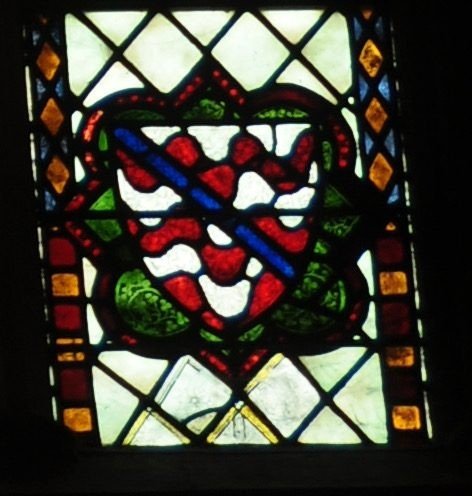
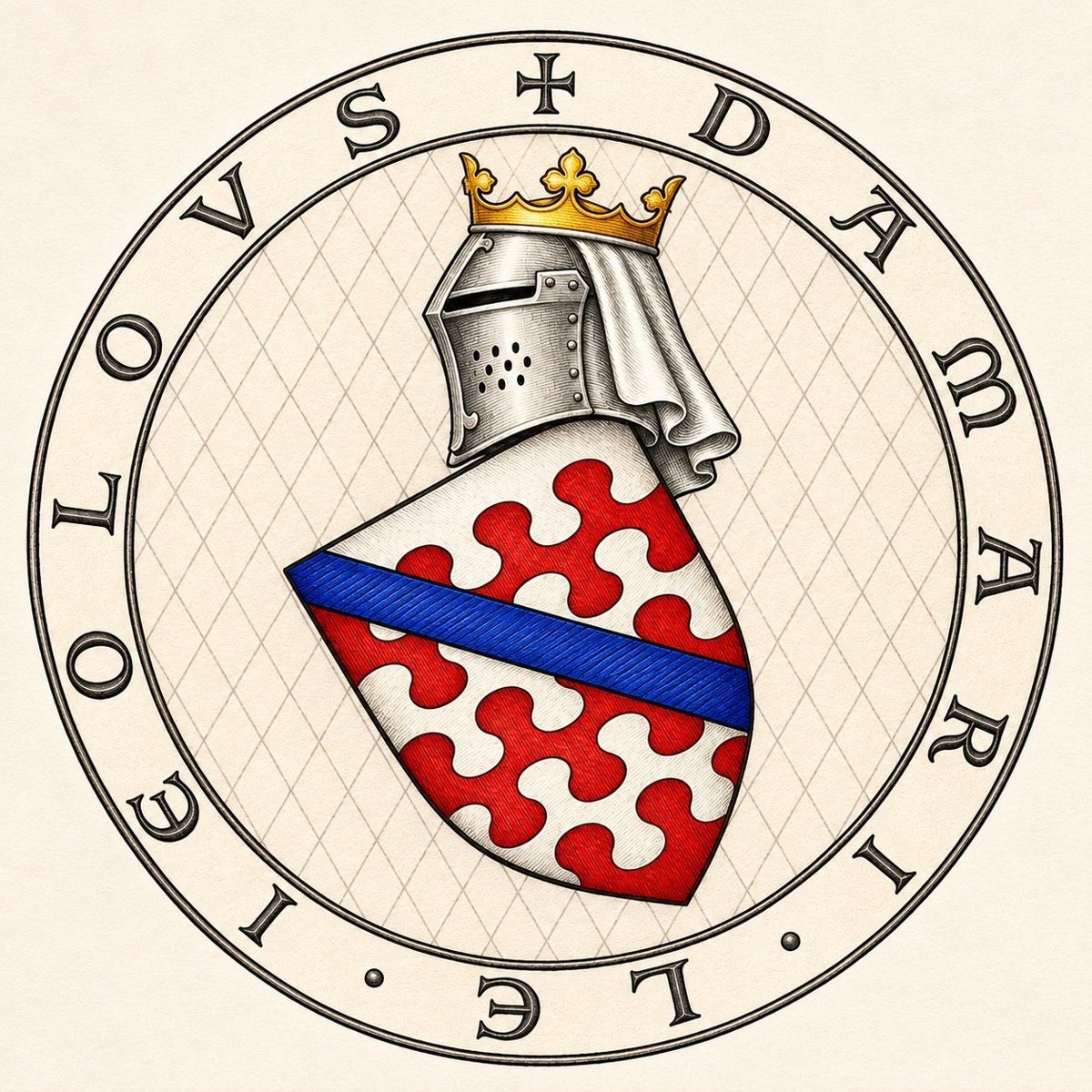
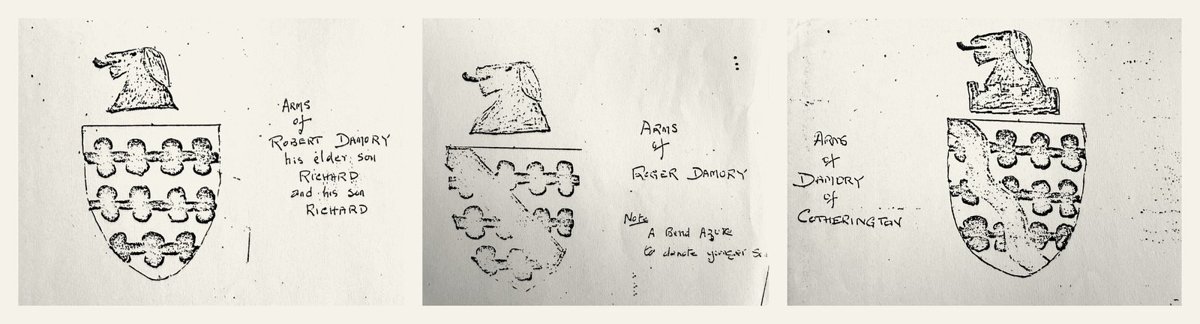
The family arms were barry wavy of six, argent and gules. Roger bore them differenced with a blue bend, barry wavy argent and gules, a bend azure, as a younger son.6 Earlier genealogists gave him a brother Nicholas. The Complete Peerage shows that this Nicholas never existed: Dugdale misread Richard’s name.7
In the earl of Gloucester’s retinue
Roger’s career began in the retinue of Gilbert de Clare, earl of Gloucester. He witnessed a grant to Bartholomew de Badlesmere with other men of the earl’s following in October 1308 and jousted for the earl at the Dunstable tournament of 1309.8 The earl gave him a life interest in the Somerset manor of Easton, one of several demesne manors he granted to “political associates among the lesser baronage”.9 So Roger was a Clare tenant before he was a Clare husband.
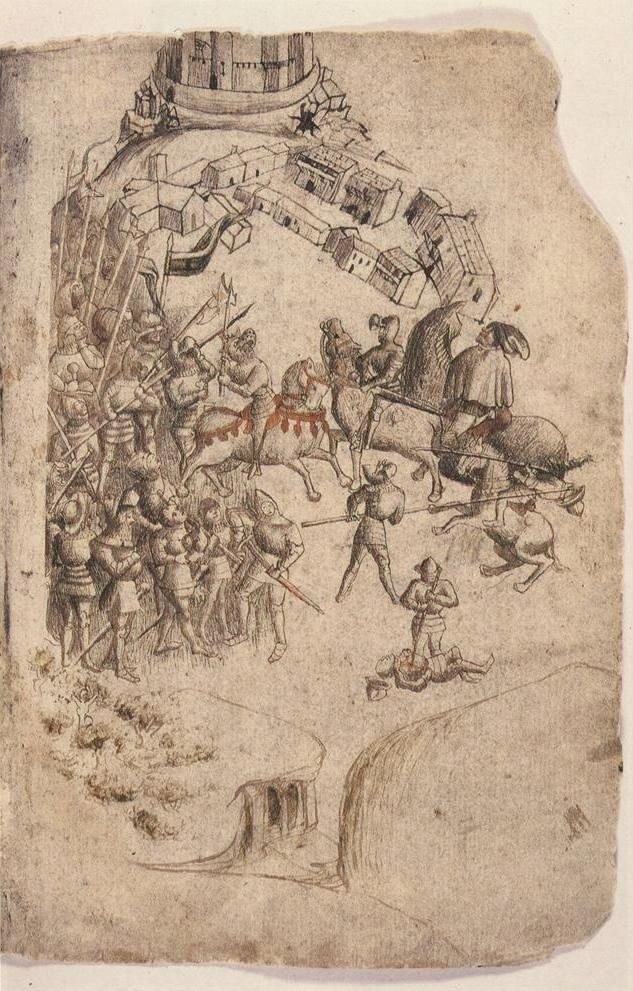
Gloucester was killed at Bannockburn on 24 June 1314. Roger fought there, and his conduct brought him to the king’s notice. Edward later rewarded him “for his good service against the Scots at Stryvelyn and elsewhere”.10
2. The king’s favourite, 1314–1317
Roger was a household knight from about January 1315, later than Hugh Audley the younger (1311) and William de Montacute (1312 or 1313), the two men with whom he is usually grouped.11 Davies lists the grants that followed from the patent, fine and close rolls:12
| Date | Grant |
|---|---|
| December 1314 | Castle and honour of Knaresborough, formerly Gaveston’s |
| February 1315 | Wardship of the Percy lands during the heir’s minority |
| May 1316 | £100 for service in Glamorgan against the rising of Llywelyn Bren |
| August 1316 | Wardship of the Verdon lands, eleven days after Theobald de Verdon’s death |
| January 1317 | 200 marks a year at the Exchequer until provided with land |
| March 1317 | Wardship of the Willoughby heir, “for his good service at Stirling and elsewhere” |
| 1317 | Manors of Holton, Sandal and Vauxhall, and houses in London |
| October 1317 | Keeper of Gloucester castle |
| 1318 | Keeper of Corfe and St Briavel’s, and of the Forest of Dean |
On 15 January 1317 he contracted to serve the king for life for an annuity of 200 marks. Audley and Montacute made the same contract that day. The normal fee for a household knight was 10 marks a year.13 Numerous Chancery grants in 1317 were issued “on the information of Roger Damory”, and privy seal writs went out at his request. The king kept a falcon called Damory, presumably Roger’s gift.14
Davies’s verdict is that “in the years 1316–18, Damory was the supreme influence at court, easily out-pacing all his competitors, including the younger Despenser”.15 Phillips agrees that of the young favourites Damory “appears to have been the most influential”.16
At the council at Clarendon in February 1317, Damory, Audley and Montacute were the men alleged to have called Lancaster a traitor. The Flores Historiarum, hostile to the king, described them as rising “in the king’s shadow” and worse than Gaveston.17
3. Elizabeth de Clare before the marriage
Elizabeth was born at Tewkesbury on 16 September 1295, the youngest daughter of Gilbert de Clare, earl of Gloucester, and Joan of Acre, daughter of Edward I. She was Edward II’s niece.18 On 30 September 1308, she married John de Burgh, eldest son of the earl of Ulster; their son William was born on 17 September 1312, and John died on 18 June 1313.19
Her brother’s death at Bannockburn made her and her sisters, Eleanor and Margaret, heirs to the Clare lands in England, Wales and Ireland, valued at about £6,500 a year.20 The settlement of 1290 had entailed the lands on the children of Gilbert and Joan. Edward II delayed the partition, using the dowager countess’s claimed pregnancy as his reason, while he arranged husbands for the two widowed heiresses. He recalled Elizabeth from Ireland in February 1316 and lodged her at Bristol castle. Theobald de Verdon, lord of Ewyas Lacy and Alton, carried her off and married her without licence. He died on 27 July 1316 and was buried at Croxden Abbey.21
Within days the king gave Roger the wardship of the Verdon lands. On 12 September 1316, before Verdon’s funeral, a privy seal letter written at Beverley sent the chamberlain John Charlton to Elizabeth “concerning your estate and your honour”, asking her to do willingly what he would request on the king’s behalf “if you wish to have generous lordship from us”. The sentence about generous lordship was added above the line. The letter does not name Damory, but Phillips and Warner both read it as pressure towards the marriage.22 Elizabeth was then about a month pregnant by Verdon.
Underhill sets out why refusal was hardly possible. Her dower and the Verdon wardship were in others’ hands; her Irish dower was threatened by the Bruce invasion; the Clare lands were undivided; her parents were dead; and the head of her family was the king. Magna Carta allowed a widow to refuse remarriage, but insisting on that right might have cost her the Clare share, and taking the veil would have handed her share to her son.23
4. The marriage, 1317
Elizabeth went to Amesbury Priory, where her aunt Mary was a nun. There she gave birth to Verdon’s posthumous daughter, Isabella, on 21 March 1317. Queen Isabella and Mary were godmothers.24 The king came to Amesbury about 10 April, bringing Roger with him.25
The date of the wedding is not recorded. Elizabeth could not have been churched before about 30 April, and the Patent Roll names “Roger Damory and Elizabeth his wife” on 3 May 1317. Her sister Margaret married Hugh Audley at Windsor on 28 April. Underhill and Warner both place Elizabeth’s wedding at Windsor in the first days of May, while her thanksgiving pilgrimage party spent five days with the king there; when the party moved on to Canterbury and St Albans, its horses increased, which suggests Roger had given his new wife an escort.26 Roger was then in his thirties and Elizabeth twenty-one.
The partition moved quickly once both sisters were married. Formal orders were issued on 12 May, the husbands did homage for the division on 22 May, and delivery of the shares was ordered on 15 November 1317.27 Within days of that order, the burgesses of Clare paid Roger £4 as a recognition of his succession, his first appearance as lord in his own town’s court roll.28
The Damory share
Roger and Elizabeth’s third of the inheritance, set out in the partition rolls, comprised:29
- Suffolk: Clare castle, manor and borough; Hundon, Lakenheath, Southwold, Sudbury and Woodhall.
- Dorset: Cranborne, Pimperne, Portland, Steeple, Tarrant Gunville, Wareham, Weymouth and Wyke.
- Essex, Hertfordshire, Kent, Norfolk and Somerset: Bardfield and Claret; Standon; Southfrith forest and West Peckham; Bircham and Walsingham; Easton.
- Wales: the lordships of Usk and Caerleon, with the castles of Usk, Trellech, Caerleon, Tregrug and Llantrisant.
- Ireland: a third of the liberty of Kilkenny.
Usk and Caerleon were part of the dowager countess’s dower, so Roger and Elizabeth did not take possession of them until her death in 1320.30 The 1317 values were close for the three shares: Warner gives £1,391 a year for the Damorys in 1317, rising to £2,274 after the dower fell in.31 Roger also controlled Elizabeth’s de Burgh jointure and Verdon dower, and held the rest of the Verdon lands in wardship. He and Audley were summoned to parliament as barons from 20 November 1317, by writs to “Rogero Damory”, and the Complete Peerage treats him as Lord Damory.32 Two days later, on 22 November 1317, he sealed a deed at Westminster with a new seal: his shield beneath a helm and crest, and round it the legend Damari le Ieolovs, “Damory the zealous”.33
How Elizabeth regarded it
Underhill called the circumstances of the marriage “brutal and unfeeling” and the match a step down for a king’s granddaughter. Warner thinks it no worse than most noble marriages and notes that Roger, unlike Verdon, sought her consent.34 Neither has direct evidence of Elizabeth’s feelings in 1317. The evidence of what she thought of him later is considerable, and is set out in section 11.
5. Lancaster’s enemy, 1317
On 1 June 1317, in the king’s presence at Westminster, the two Despensers, Audley, Damory and Montacute bound themselves to one another in recognisances of £6,000 each. No purpose was stated. Phillips reads the bonds as insurance against any attempt by Lancaster to drive them from court: if they hanged, they would hang together.35 These bonds came back to Elizabeth seventeen years later as a £12,000 debt.
That summer Lancaster refused to attend the council at Nottingham and demanded that the king purge his household. In late September, when Edward passed Lancaster’s castle of Pontefract on his way south, he drew up his men and threatened to attack, encouraged, one chronicler says, by his close associates, presumably Damory, Audley and Montacute. Pembroke talked him out of it.36
Lancaster’s answer was aimed at Damory. On 5 October his men seized Knaresborough from the constable Damory had appointed, and about the same time Alton castle, which Damory held in the Verdon wardship, was attacked. The crown took Damory’s lands in Yorkshire, Herefordshire and Lincolnshire into its own hands as a precaution, returning them on 2 December, and Knaresborough was not recovered until late January 1318 after a costly siege.37 Lancaster was also angered by Damory’s hold on the Verdon lands and the marriages of the younger Verdon daughters. Phillips concludes that Lancaster “regarded Roger Damory as his chief enemy among the royal favourites”. There is no sign that Audley or Montacute was threatened at the same time.38
The indenture of 24 November 1317
On 24 November 1317 in London, Aymer de Valence, earl of Pembroke, and Bartholomew de Badlesmere made a formal agreement with Damory. The original survives in the Exchequer.39 Damory swore on the Body of God and bound himself in £10,000:
- to do his best to persuade the king to be guided by Pembroke and Badlesmere above all others, so long as their advice was to the advantage of king and kingdom;
- not to procure or consent to any royal grant of land worth more than £20 without their knowledge;
- not to consent to anything the king did that might harm him or his crown;
- not to persuade the king to any of these things while they were absent, nor let anyone else do so;
- to warn them of anyone trying to turn the king against them.
In return they promised to defend him against all men except the king. Each side sealed the other’s part.
Stubbs, Tout and Davies read the indenture as the founding document of a “middle party” led by Pembroke, standing between Lancaster and the favourites. That view held until the 1970s. Phillips, followed by Maddicott and Prestwich, overturned it: Pembroke and Badlesmere were long-serving royal councillors, both themselves under contract to the king, and the purpose of the indenture was “to control and to restrain Damory’s conduct” at the moment his share of the Gloucester inheritance was being delivered to him.40 Phillips’s harshest verdict belongs to this year. He describes “the malignant character and activities of Roger Damory”, a man too dangerous to be so close to “the weak and easily influenced Edward II”, who had “done much to wreck the attempts during 1317” at a settlement.41 No similar agreement with Audley or Montacute survives.
Underhill notes that Damory was still speaking for the king in Chancery in November 1317. On 1 November he founded a chantry at Bindon Abbey in Dorset for the good estate of himself and the king. It names neither Elizabeth nor the child she was then carrying.42
6. Leake, and the years at Clare, 1318–1320
The king at Clare. Edward stayed with Roger and Elizabeth at Clare from 23 to at least 27 March 1318. Bishop Thomas Cobham preached indulgence sermons at the Clare friary for the soul of Joan of Acre while he was there. Just before, the king sold Roger the marriages of the two younger Verdon stepdaughters for £200. Roger later sold Margery de Verdon’s marriage to Sir Robert Holland, Lancaster’s steward.43
A daughter, May 1318. On or a little before 23 May 1318 the king’s wardrobe paid Roger’s messenger £20 for the news that Elizabeth “had borne Damory’s daughter”.44 The Complete Peerage identifies this child as Elizabeth Damory; Warner thinks she was an elder daughter, Margaret, which the evidence set out in section 13 favours.
The road to Leake. In June 1318 five of the king’s closest associates, the elder Despenser, Damory, the younger Audley, Montacute and John Charlton, promised not to impede Lancaster when he came to make peace. The first draft admitted that Lancaster had kept away from court “because of us, as people say”. That clause was struck out, and the document was apparently never sealed.45 In July Lancaster agreed to remit all offences against him except those of Damory and Montacute, “whom he accused of plotting to kill him”. At Northampton the Vita found Lancaster’s enemies, Damory among them, gathered “in great strength, so that you would have thought they had come not to parliament, but to battle”.46 The Treaty of Leake was sealed on 9 August 1318. Afterwards, the Vita says, “Roger Amory and the rest, except Hugh Despenser and the earl Warenne, humbly presenting themselves before the earl, were received into his grace”.47
The York parliament, autumn 1318. The royal grants were reviewed. Damory’s were confirmed with reductions, and he kept most of what he had been given. On 23 November he made his peace with Lancaster by acknowledging a debt of 906 marks 7s 4d in compensation, which was certainly paid, and he then left court.48 The Chancery entries “on the information of Roger Damory” stop after December 1318. Phillips sees the rise of the younger Despenser as partly a result of Damory’s removal.49
Still in favour. He was not out of favour for long. At the siege of Berwick in 1319 he served with a retinue of 82 men, more than Audley and fewer only than Hereford, Despenser and Badlesmere, and the king allegedly promised him the keeping of the town.50
Between November 1318 and 1320 he lent large sums, £400 to Sir Simon Warde alone, and bought the Surrey manor of Kennington.51 In 1320 his debts to the crown were respited and part of a 2,300-mark fine was pardoned. He went with the king to France in June 1320, leaving his brother Richard as his attorney.52
Their household. The household accounts for 1319–21 survive in part at the National Archives.53 They show a household of at least fifty, run in Roger’s name, with Elizabeth appearing occasionally as “the lady”. A day’s provisions included 40 gallons of ale, 8 of wine and 150 eggs. They paid for furs, spices, red sealing wax and silver plate, and over £250 to Italian merchants. That winter they were at law with Elizabeth’s sister-in-law Maud de Burgh, with retained London counsel and four barrels of sturgeon sent to a friendly knight. The king visited them at Kennington in April 1320, and Queen Isabella and her retinue stayed with them that October and November.54 On 25 August 1320, at Reading, Roger made a three-way agreement with the earl of Ulster and the elder Despenser over Elizabeth’s de Burgh dower lands in Tipperary and Kerry.55 On 26 October 1320, at Kennington, Roger and Elizabeth arranged with the Augustinian friars of Clare for two friars to say Mass daily in Clare castle for their lifetimes.56 It is the last joint act of theirs on record.
7. Against the Despensers, 1320–1321
Usk came to Roger and Elizabeth in 1320, the year the younger Despenser began trying to take it. Despenser had already worked against Audley in Gwynllwg. The Tintern writer of the Flores, whose house was in Damory’s lands and whose patron he was, says that Despenser tried to take Damory’s share by force “but that the latter successfully resisted”.57 On 5 November 1320, at the request of Despenser, Damory and Audley, the king confirmed the 1290 settlement of the Gloucester lands, which Phillips reads as a guarantee to Damory and Audley that Despenser would take no more of their shares.58 By then Phillips’s comment applies: “it was already too late”. Damory did not witness any of the charters issued at the October 1320 parliament, and his last gift from the king was a respite of fines that autumn.59
Underhill thinks Damory came late to the opposition, without a grievance of the kind the Vita lists for the other Marchers: “the favorite gradually became Damory the foe”. The record gives him a grievance all the same. Despenser’s target was the whole of the Gloucester inheritance, and Usk was the share he had not yet got.
March to May 1321. In March the king, on his way to the March with Despenser, seized St Briavel’s from Damory, and removed him as keeper of St Briavel’s and the Forest of Dean on 11 April and of Corfe on 8 May.60 On 4 May the Marcher lords began attacking Despenser’s lands. Newport, Cardiff and Swansea fell within ten days. Despenser handed his castles to the king, but Glamorgan, Despenser’s own share of the inheritance, stayed in Damory’s hands.61 A message the Marchers sent to the mayor of Bristol that month names the leaders as “the earl of Hereford, Sir Roger de Mortimer the uncle, Sir Roger de Mortimer the nephew, Sir Roger Damory, Sir Maurice de Berkeley and the other barons of their alliance”.62 Roger’s sister Katherine and her husband robbed six Oxfordshire manors of the Despenser retainer John Haudlo the same year.63
Sherburn, June 1321. At Sherburn-in-Elmet on 28 June Lancaster met the Marchers and the northern lords. Damory is named in the indenture drawn up there as one of the Marchers whose case against the Despensers was heard.64 Badlesmere, who had bound Damory in 1317, went over to the Marchers at the same meeting. The man Lancaster had attacked in 1317 was now his ally.
London, August 1321. The Marchers came to the parliament at Westminster with about 5,000 men, quartered outside the city: Mortimer at Clerkenwell, Hereford at Holborn, Damory at the New Temple and Audley at St Bartholomew’s, Smithfield. The archbishop and bishops met the magnates several times at the New Temple to seek a settlement.65 The award against the Despensers, read in Westminster Hall on 14 August, charged that the younger Despenser had plotted “by false schemes” to get the lands of Sir Roger Damory so as to obtain the whole earldom of Gloucester.66 Davies points out the irony of one of the charges, that Despenser had made an indenture to restrain the king’s will, coming from a man who had sealed one himself in 1317.67
The pardons. The Despensers were exiled and the magnates pardoned on 20 August 1321. Damory then vouched on his oath for his own followers. The patent roll lists about a hundred men pardoned “at the testimony of the said Roger Damory” between 20 August and 25 September, more than on Roger Mortimer’s testimony.68 Davies counts 103 pardons on Damory’s word, against 45 on Audley’s, 47 on Hereford’s and 60 on Mortimer of Wigmore’s.69 Among them were Maurice, Lord Berkeley and his son, John Maltravers the younger, John and William de Beaumont, the de la Beches, John Luttrell and Henry de Wylington. Several came from his own lands, among them men of Sudbury and of the country around Standon. Warner notes that a lord of Berkeley’s standing was classed as Damory’s follower, not the other way round. On 16 August Edward told the bishop of Rochester at dinner that within half a year he would make such amends “that the whole world would hear of it and tremble”.70
8. Civil war and death, 1321–1322
In August, September and November 1321 the king ordered Damory to hand Glamorgan to royal keepers. Damory replied that the men of the country had put him in possession and that handing it over would make them think Despenser was coming back. The king called the answer “altogether insufficient and derisory”.71 His lands in Essex, Suffolk and Hertfordshire were seized on 22 November, and his ship at Weymouth, his Irish goods and his Welsh castles were taken. By 17 February 1322, £300 raised from the estates of Damory and Badlesmere had already reached the keeper of the wardrobe to pay for the campaign against them.72
After the king left Worcester on 7 January 1322, Damory retook the town for the Marchers. When the Mortimers surrendered at Shrewsbury later that month, he went north with Hereford and the younger Audley to join Lancaster.73 The king’s letters to the sheriffs named “Rogerus Damory” among the rebels.
Burton and Tutbury. On 1 March Lancaster and Hereford held the river crossing at Burton-on-Trent. On 10 March the royal army outflanked them by a ford and a bridge downstream. Lancaster and Hereford fled north to Pontefract, abandoning Tutbury castle, “which the King captured on the same day along with the mortally wounded Roger Damory”.74 Underhill thinks he was wounded defending the crossing.75 The Complete Peerage has him left behind at Tutbury “being sick, or mortally wounded” and captured on 11 March.76
The judgment. On 13 March 1322 he was tried at Tutbury as a plea of the army, before the constable, the marshal and Geoffrey le Scrope. The record survives because Edward had it called into King’s Bench in 1324–5.77 It charges him with going into Wales with banners displayed, taking the king’s town and castle of Gloucester, burning Bridgnorth, besieging Tickhill, joining Lancaster and Hereford to hold the bridge at Burton against the king and burning the town, and fleeing north robbing the country “until you came to Tutbury”. The king recorded these as notorious, and on his record the court sentenced Damory, without hearing him, to be drawn for treason and hanged for the homicides, arsons and robberies.
The sentence ends: “but, Roger, because our lord the king loved you much in times past, and you were of his household and close to him, and have married his niece, our lord the king of his grace and royalty puts the execution of this judgment in respite at his pleasure”.78
Death. He died at Tutbury within a day or two. Bridlington says Damory was found in the castle when the king took it; Knighton that he “died fairly in his bed at Tutbury, in the castle”; the Vita that he did not live beyond the third day; and the French Chronicle of London that he died of grief.79 The Complete Peerage gives 13 or 14 March 1322 at Tutbury castle.80 Warner places him in Tutbury Priory, the Benedictine house beside the castle, and Phillips in “the neighbouring abbey”.81 The chronicle evidence favours the castle.
Elizabeth kept his anniversary on 12 March, the feast of St Gregory.82 She kept John de Burgh’s and Theobald de Verdon’s on their exact dates, but her father’s and brother’s a day out, so 12 March may or may not be exact. The king left Tutbury for Derby on 12 March. If Roger died that day, the judgment of the 13th was passed on a dead man, which may explain why the sentence was respited at all.
Three days later, on 16 March, Lancaster’s army was defeated at Boroughbridge and Hereford was killed. Lancaster was condemned and beheaded outside Pontefract. Damory’s summary trial without a hearing followed the precedent of the award against the Despensers in 1321, and preceded Lancaster’s by a week.83
9. Burial at Ware
Roger was buried in the parish church of St Mary the Virgin at Ware, Hertfordshire. John Weever recorded the monument in 1631, in the middle aisle:84
Hic jacet Rogerus Damory, baro, tempore Edwardi Secundi, et Elizabetha, tertia filia Gilberti Clare, comitis Glocestriae, et Johannae uxoris ejus, filiae Edwardi primi vocat. Johan de Acris.
Here lies Roger Damory, baron in the time of Edward II, and Elizabeth, third daughter of Gilbert de Clare, earl of Gloucester, and of Joan his wife, daughter of Edward I, called Joan of Acre.
By 1728 only the coronet remained, and by 1780 there was no memorial at all.85 The Complete Peerage accepts the burial at Ware. Its 1998 addenda correct only Elizabeth’s entry: she was buried at the Minoresses outside Aldgate, as her will directed, not with Roger.86 Warner’s doubt about Ware rested on the Franciscan friary there, which was not founded until 1338. Weever’s evidence puts the tomb in the parish church, so the friary’s date does not affect it.
Who arranged the burial is not recorded. Roger died a condemned prisoner in the king’s custody, and Elizabeth was held at Barking. Natalie Fryde wrote that Edward “gave him an honourable burial”, but gives no source.87 His brother Richard was under arrest until 16 March, two or three days after Roger’s death, and the date of the burial is unknown.88 Ware belonged to Thomas, Lord Wake, not to Roger or Elizabeth, and lay more than a hundred miles from Tutbury. It was, however, the nearest town of any size to Standon, about six miles away. Standon was Elizabeth’s principal Hertfordshire manor, described for the years 1304–14 as one of the most valuable Clare properties in eastern England, and it was first in the list of manors of her inheritance in her will.89 A burial at Ware placed Roger close to his wife’s land without burying a condemned man in a church of her own.
The monument Weever saw was not made in 1322. Its inscription calls Roger “baron in the time of Edward II”, which looks back on a finished reign, so it was made after January 1327 at the earliest. It names Elizabeth as lying there too, though she chose burial in London. The Victoria County History records a fourteenth-century slab with the indent of a floreated cross in the floor of the north transept, perhaps from an altar tomb that once stood there; nothing connects it to Roger, but it is the only medieval tomb slab of that date noted in the church.90 Elizabeth’s surviving accounts show her remembering her husbands with masses and alms, not tombs, but her accounts for 1322–6 are lost, so she may well have paid for this one when she recovered her lands.91
10. Elizabeth after Roger, 1322–1330
Barking. Elizabeth was arrested at Usk a few days before Roger died and taken with her children to Barking Abbey, where she learned of his death. On 16 March 1322 the king ordered her not to leave the abbey gates or marry without his consent. She was held there more than six months. The sheriff of Essex advanced £74 for her keep.92
Usk for Gower. The king held her lands and Roger’s. He offered her restoration of her inheritance and dower, and of the lands she had held jointly with Roger, on condition that she exchange Usk and her Welsh lands for Gower, which Despenser had been given in July 1322 and which was worth much less. At Barking on 29 June she granted Usk away, and on 10 July she was licensed to receive Gower in exchange. Despenser had Gower stripped “for our profit” before she got it and was granted the corn, cattle and goods at Usk. Her English and Irish lands came back on 2 November, but of the lands held jointly with Roger she was allowed only the manor of Holton. Kennington went to the elder Despenser, Caythorpe to the earl of Richmond, and Roger’s London houses and Yorkshire lands to others.93
York, Christmas 1322. Summoned to the king’s Christmas at York in the hope of recovering the rest, she was kept “as it were under guard”, her councillors removed and some imprisoned, until she sealed a quitclaim of Usk and a bond not to marry or grant land without licence. She left for Clare; five days into the journey she was ordered back under threat of losing all her lands, and sealed it. In 1324 Despenser had William de Braose bring a writ of novel disseisin for Gower against her, won it before compliant justices, and the elder Despenser passed it to his son.94
The protest of 1326. On 15 May 1326, in the small chapel beside her chamber at Clare castle, before two advisers and a notary, Elizabeth dictated a protest against all this. It survives only because a copy was kept among the title deeds of Usk in the Mortimer cartulary.95 It opens:
In the name of God, I Elizabeth de Burgh, one of the sisters and heirs of Sir Gilbert de Clare late earl of Gloucester, and formerly wife of Sir Roger Damory … my lord Sir Roger was one of those great men and was harried and oppressed so that he died. While he was still alive I was captured in the castle of Usk, part of my inheritance, by power and command of the king, and taken to the abbey of Barking where after my lord’s death I remained imprisoned more than half a year.96
She wrote of fear for herself, her lands “and my children who were imprisoned with me”, and said she would make the protest openly “if fear of royal power with the peril that could follow did not stop me”. Published, it could have cost her her lands. Holmes, who edited it, found her account “corroborated at all important points by independent evidence”.97 Underhill thinks its timing shows she knew of Queen Isabella’s planned invasion, through her friends Joan of Bar and Mary de St Pol, who were with the queen in France. It ends with her hope for a time “when grace was dispensed more openly and the law of the land better maintained and common to all”.98
Invasion and restoration. Isabella landed in Suffolk in September 1326. Elizabeth equipped a man for the queen’s army and sent others to her “on the lady’s secret business”. Usk and Caerleon were restored to her on 26 February 1327, and her bond not to marry was cancelled. Underhill notes that the queen had been on Roger’s side from 1317 to 1321 and had been godmother to Isabella de Verdon, whose marriage she now controlled because it had been Roger’s wardship, forfeited in 1322.99
11. Clearing his name
The Crown still claimed thousands of pounds of Roger’s debts after 1327, and fines against him were demanded from his widow.100 Elizabeth worked for eighteen years to clear them. In October 1329 she was pardoned 2,000 marks he owed the Exchequer. In 1331 the Crown paid her £1,500 of an old royal debt to Roger, which she used at once to buy the wardship of Laurence Hastings, heir to the earldom of Pembroke, a wardship the younger Despenser had held. In June 1334 Edward III pardoned the £12,000 in recognisances that Roger had made to the Despensers in 1317, which had passed to the Crown, after she said they “were made by compulsion”. In 1338 she recovered £141 4s 4d for a gold and silver vessel Roger had pledged to the Bardi, which Edward II had taken for himself. In 1337 she was given a lifetime respite, and in 1340 the king declared her quit of all debts relating to Damory.101
Three other things show how she regarded him.
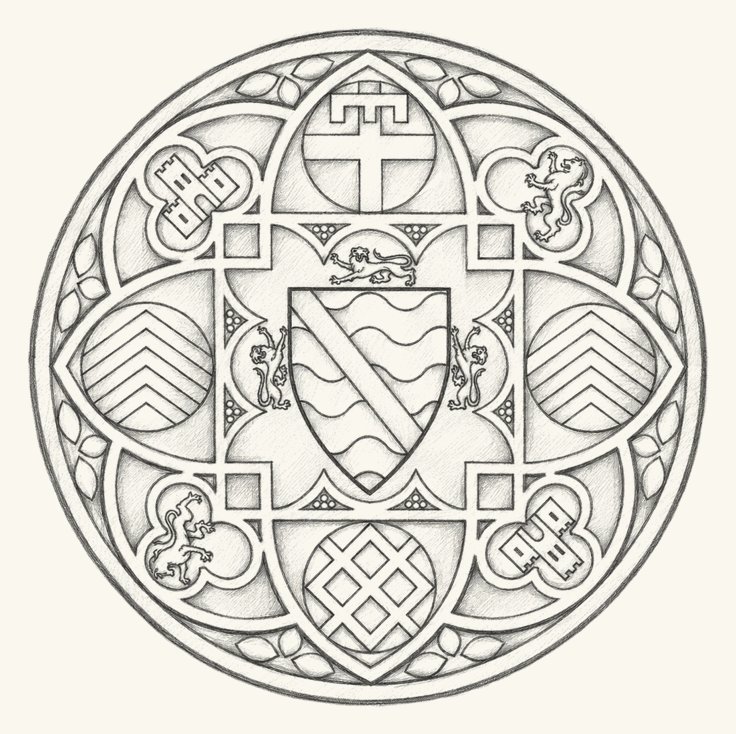
Her seal. Elizabeth had two personal seals. On the first, in use from 1327 to 1352, Roger’s arms are on the shield at the centre, ringed by the lions of England for her grandfather Edward I, with the Clare chevrons to either side, the arms of John de Burgh above and of Verdon below, and Castile and León in the margins. On the second, from 1353 to 1360, the centre shows Clare impaling de Burgh within a black border powdered with gold drops for her widowhood, the arms Clare College still uses. Roger’s arms are still there, in a roundel at the edge. From 1322 until her death every document she sealed carried his arms.102
His anniversary. Each year she kept 12 March as Roger’s anniversary. On 12 March 1351, the twenty-ninth, she provided wheat for 1,240 loaves and 900 herring for the poor.103
Her will. In 1355 she left £140 “for masses to be sung for the souls of Sir John de Burgh, Sir Theobald de Verdun and Sir Roger Damory, my lords”, and 100 marks to send five men-at-arms to the Holy Land “for the souls of my lords, Sir John, Sir Theobald, Sir Roger, and mine”. Thirty-three years after his death as a condemned traitor she named him with the others as “my lord”.104 The statutes she gave Clare Hall in 1359 ordered a daily requiem for the kings of England and “our husbands, children, parents and benefactors”, so Roger was prayed for at Clare, though not by name, until the Reformation.105
12. The Lady of Clare, 1330–1360
From 1330 Elizabeth lived as a wealthy widow, with an income above some earls, managing her own estates. Some time before 1340 she took a vow of chastity before a bishop, receiving a plain ring and a russet habit, which put her beyond a fourth marriage.106 Her son William, earl of Ulster, was murdered by his own men in Ireland on 6 June 1333, aged twenty. She settled Usk, Caerleon, her Welsh manors and Bardfield on Isabella de Verdon and her husband Henry Ferrers, and the rest on her granddaughter, the heiress of Ulster. Ferrers died in 1343 and Isabella in 1349, so in the end the Clare lands went through the Ulster heiress to Lionel of Antwerp, the Mortimers and the house of York.107
Her year followed a pattern: Clare in late January, Anglesey Priory near Cambridge for Lent and Easter, Clare or Bardfield for summer and autumn, and after 1353 long stays at the house she built at the Minoresses’ convent outside Aldgate. She rarely visited her Dorset lands, the Verdon lands, “or the Damory lands in the Northeast”. Her livery list for 1343 names over 250 men and women. She entertained Edward III at Caythorpe, a manor she had held jointly with Roger, in August 1330.108
Her closest friends were Mary de St Pol, countess of Pembroke, Joan of Bar, countess of Surrey, and Queen Isabella, and among men Henry of Lancaster and the Black Prince. Nicholas de la Beche, whom Underhill calls “her old Damory associate”, was still in her circle in 1340.109
Clare College. University Hall, founded in 1326 by Richard Badew, was failing by the 1330s. Elizabeth gave it the advowson of Litlington in 1336, took over its patronage when Badew renounced his interest in 1346, renamed it Clare Hall, and endowed it with further advowsons. She gave it statutes in 1359, charging its fellows “to give light to them that walk in the dark paths of ignorance” and providing for poor boys “chosen from amongst the poorest that can be found”. Her preamble still stands at the head of the college statutes.110 She also founded the Franciscan friary at Walsingham in 1347.111
Death. She made her will at Clare on 25 September 1355, just after her sixtieth birthday. It opens: “I leave my soul to God and to his sweet mother St Mary and to all the saints of Heaven, and my body to the earth to be buried at the house of Minoresses outside Aldgate in London.” She died on 4 November 1360, probably at Clare or Bardfield, and her household carried her body to the Minories.112 Underhill’s judgement is that through good stewardship, imaginative philanthropy and an example of what a woman could do, she left a legacy more meaningful than most of her more famous contemporaries.113
13. The children
Two daughters. An assize roll of the Gloucestershire assizes, taken at Gloucester in July 1329, records a claim against Elizabeth de Burgh and others for a disseisin. Her attorney answered that “quidam Rogerus Dammory quondam vir ipsius Elizabeth”, Roger Damory, formerly her husband, died seised of the manor, “post cuius mortem predictum manerium descendit quibusdam Margarete et Elizabeth ut filiabus et heredibus ipsius Rogeri”: after his death it descended to Margaret and Elizabeth as his daughters and heirs. Elizabeth de Burgh held it only as guardian of the two girls, who were under age, “ut propinquior amica”, as their nearest friend, because the manor was held in socage.114 Margaret is named first each time. A Despenser letter of 1322 agreeing that “the lady’s nurses” be moved from Usk to Gower places young children with Elizabeth at Usk that year, and the 1320 agreement with the earl of Ulster speaks of the couple’s “children”.115
Which daughter was born in May 1318 is disputed. The Complete Peerage gives Elizabeth Damory’s birth as shortly before 23 May 1318, and Underhill’s family chart follows it. Warner thinks the May 1318 child was Margaret, and that Elizabeth was born in 1321 or 1322, possibly after her father’s death.116 The inquisition taken after her mother’s death in 1360 calls Elizabeth “thirty years and more”, which only means she was born by 1330, so it does not decide the matter. Three things favour Warner: the 1329 assize roll names Margaret first, twice, which usually means the elder; the wardrobe entry of 1318 records a daughter but not her name; and the nurses at Usk in 1322 point to a child still in infancy then. The likeliest reading is that Margaret was born in May 1318 and Elizabeth about 1321–2. Nothing more is known of Margaret. She does not appear after 1329, and by 1337 Elizabeth was called Roger’s heir.117 Late in life her mother had masses said for “her daughter Margaret”, which Underhill could not explain; the 1329 roll suggests the answer.118
Elizabeth Damory and the Bardolfs. In 1327 Elizabeth Damory married John Bardolf, heir of Thomas, Lord Bardolf of Wormegay in Norfolk. Her mother gave her a dower of 500 marks and promised Thomas an annual pension. John was born on 13 January 1314.119 Elizabeth was the least well endowed of her mother’s children: almost everything she stood to inherit from Roger was in jointure lands her mother held for life, and John’s mother kept her full dower until 1358. To help them, her mother exchanged Roger’s Surrey manors of Kennington and Vauxhall with the Crown for Ilketshall, Clopton and Claret in Suffolk, to pass to the Bardolfs after her death. She lent John money that was still owed when she died.120
For thirty years Elizabeth de Clare kept her daughter close. The Bardolfs came to Clare at Christmas and again in summer, with music from a portable organ, and her mother paid their travel and kept rooms for them at Anglesey Priory. In December 1339 she sent her great carriage with five war-horses to fetch “Lady Bardolf” from Anglesey to Bardfield. The couple went with her to Walsingham in 1347 when she founded the friary. Underhill concludes that affection, not advantage, explains the closeness.121 Their son William, later 4th Lord Bardolf, was born at Wormegay on 21 October 1349.122
In her will Elizabeth de Clare left her daughter her bed of green velvet striped with red, a hall of worsted hangings with parrots and blue cockerels on a tawny field, and her great coach with its curtains and cushions. Her granddaughters Isabel and Agnes Bardolf each received a bed and plate “in aid” of their marriages. Her grandson William received nothing.123 When she died in 1360 the inquisitions named Elizabeth Bardolf as heir to Roger Damory, and in February 1361 Elizabeth and John had livery of Ilketshall and Clopton, Caythorpe, Dowsett in Standon, and land in Cranborne.124 Elizabeth Damory died in 1361 or 1362, before her husband, who died at Assisi in 1363. The Complete Peerage notes that any hereditary barony of Damory “was thus united to that of Bardolf”.125
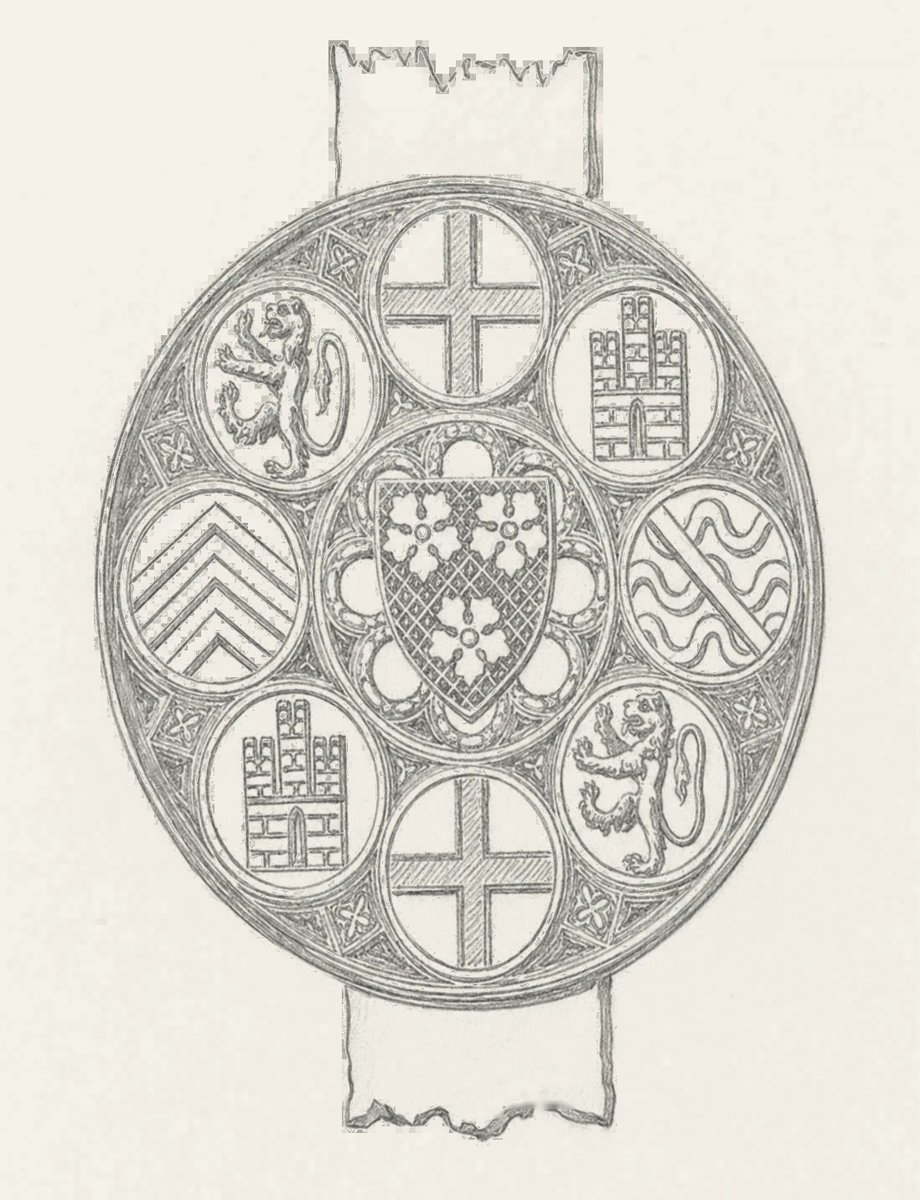
The seal of Elizabeth, Lady Bardolf, Roger’s daughter: the Bardolf cinquefoils at the centre, ringed by the arms of her ancestry, Damory, Clare, de Burgh, Castile and León. Redrawn from Boutell, fig. 299. © Aynsley Damery, 2026.
Sir Nicholas Damory. Nicholas Damory was in Elizabeth de Clare’s service for forty years. He was a lawyer and knight, steward of the household of Edward III’s daughter Isabella, an executor of her will and first among her household in it, and he died in 1381.126 His parentage has been read three ways: the Complete Peerage makes him a first cousin of Roger’s nephew Richard; Warner suggests he was Roger’s natural son; Ward calls him Roger’s nephew. The King’s Hall records at Cambridge settle most of it. On 14 April 1318, at the height of Roger’s favour, “William Damory, Richard Damory, Nicholas Damory” were admitted as king’s scholars; in December 1319 the same three appear as “William Pour, Richard Pour, Nicholas Pour”, and the editors identify them as the same boys.127 Roger’s sister Katherine was married to Sir Walter Poure. The most probable reading is that Nicholas was Roger’s nephew, a son of Katherine and Walter Poure, entered under his uncle’s name when his uncle was the king’s favourite. That makes him a first cousin of Richard Damory the younger, exactly as the Complete Peerage has it. The Victoria County History for Oddington lists Walter and Katherine’s heir as Thomas, lord by 1337, and does not mention a Nicholas. It does record that in 1327 Walter Poure won the right to present to Oddington church and the bishop was ordered to admit a William Poure, a name that matches the eldest of the three King’s Hall boys.128 A deed naming Nicholas as Walter Poure’s son would settle it.
The young Roger. A boy called Roger Damory lived in Elizabeth’s household as a ward from 1331 to 1336. The accounts record his supplies and his escort to London but not who he was. Warner thinks him Roger’s natural son; Underhill suggests he may have been a brother of Nicholas, which would make him another Poure nephew named after his uncle.129
14. The descent
The Damory line continued through Elizabeth Damory and the Bardolfs. From William, 4th Lord Bardolf, it runs through his daughter Cecily, who married Sir Brian Stapleton of Ingham, and through the Calthorpes, Drurys, Jerninghams, Cornwallises and Southwells of Norfolk and Suffolk. Sir Thomas Southwell came to County Cork for the plantation of Munster under James I. His daughter married Sir John Dowdall, and her daughter married Sir Hardress Waller. Through the Wallers, the Evanses of Miltown Castle, the Lucases of Richfordstown and the Smyths of Castle Downeen it comes to Eliza Hester Smyth, who married Harry Jones of Drombeg at Glandore in 1861. Her granddaughter Alice Dorothy Jones married Alfred Norman Damery. The route could be called circuitous, but every step has been verified. The record for each link is set out on the Damory descent page at damery.family.
Roger Damory and Elizabeth de Clare are my twenty times great-grandparents.
15. Questions still open
- The day of death. The chroniclers give 13 or 14 March 1322; Elizabeth kept 12 March. The Vita edition’s note on his death, and the household accounts for March 1322, may settle it.
- Castle or priory. The chronicles put his death in Tutbury castle; Warner puts it in the priory.
- Who buried him at Ware, and when the monument was made. A payment in the wardrobe accounts for 15 Edward II (TNA E 361/2), or an entry in Elizabeth’s accounts after 1327, would answer it.
- The births of Margaret and Elizabeth Damory. The 1329 assize roll shows both under age and Margaret named first, but gives no ages. Proofs of age, if any survive, would settle it.
- Nicholas Damory’s father. The Victoria County History for Oddington does not name him; a Poure family deed may.
- The young Roger Damory of 1331–6.
- Roger’s earlier life. Warner notes that he may have had an earlier marriage and natural children. Nothing firm is known.
Appendix: chronology
| Date | Event |
|---|---|
| c. 1280–85 | Roger born, younger son of Sir Robert Damory of Bucknell |
| 1295, 16 Sept | Elizabeth de Clare born at Tewkesbury |
| 1308, 30 Sept | Elizabeth marries John de Burgh |
| 1308–9 | Roger in the retinue of Gilbert de Clare, earl of Gloucester |
| 1313, 18 June | John de Burgh dies |
| 1314, 24 June | Bannockburn; Gloucester killed; Roger noticed by the king |
| 1314, 24 Dec | Roger keeper of Knaresborough |
| 1316, Feb | Elizabeth marries Theobald de Verdon |
| 1316, 27 July | Verdon dies; Roger given the Verdon wardship on 7 August |
| 1317, 15 Jan | Roger’s life contract with the king |
| 1317, 21 Mar | Isabella de Verdon born at Amesbury |
| 1317, c. 30 Apr–3 May | Roger marries Elizabeth, probably at Windsor |
| 1317, 1 June | £6,000 bonds with the Despensers, Audley and Montacute |
| 1317, Oct | Lancaster seizes Knaresborough and attacks Alton |
| 1317, 15 Nov | Delivery of the Clare shares ordered |
| 1317, 20 Nov | First summons to parliament |
| 1317, 24 Nov | Indenture with Pembroke and Badlesmere |
| 1318, Mar | The king at Clare |
| 1318, May | A daughter born, probably Margaret |
| 1318, 9 Aug | Treaty of Leake |
| 1318, 23 Nov | Peace with Lancaster; Roger leaves court |
| 1319 | Siege of Berwick, with a retinue of 82 |
| 1320 | Usk and Caerleon come to Roger and Elizabeth; France with the king |
| 1321, May | The Marchers attack the Despensers; Roger holds Glamorgan |
| 1321, 28 June | Sherburn-in-Elmet |
| 1321, 14–20 Aug | The Despensers exiled; 103 men pardoned on Roger’s word |
| 1322, Jan | Roger retakes Worcester, then goes north |
| 1322, 10 Mar | Burton-on-Trent; Tutbury taken with Roger in it |
| 1322, 13 Mar | Roger condemned; execution respited |
| 1322, 13–14 Mar | Roger dies at Tutbury; buried at Ware |
| 1322, 16 Mar | Boroughbridge |
| 1322, July | Usk exchanged for Gower |
| 1326, 15 May | Elizabeth’s protest at Clare |
| c. 1321–2 | Elizabeth Damory born |
| 1327 | Usk restored; Elizabeth Damory marries John Bardolf |
| 1333, 6 June | William de Burgh murdered |
| 1334 | The £12,000 Despenser bonds pardoned |
| 1340 | Elizabeth quit of all Damory debts |
| 1346 | Clare Hall founded |
| 1347 | Walsingham friary founded |
| 1349, 21 Oct | William Bardolf born |
| 1355, 25 Sept | Elizabeth’s will |
| 1359 | Statutes of Clare Hall |
| 1360, 4 Nov | Elizabeth de Clare dies; buried at the Minories |
| 1361–2 | Elizabeth Damory, Lady Bardolf, dies |
Sources
Records. The National Archives: C 47/9/23–25 (Clare partition); E 163/4/6 (indenture, 1317); E 40/386 (Ulster agreement, 1320); E 101/95/6, E 101/506/23, E 101/94/20 (Damory household accounts); SC 1/63/150, SC 1/63/183; SC 2/203/38 (Clare court roll); JUST 1/1403 (Gloucestershire assize roll, 1329); PRO 23/1498 (Elizabeth’s first seal). British Library, Harley MS 1240 (Elizabeth’s protest). Lambeth Palace Library, Register of Archbishop Islip (Elizabeth’s will). Calendars of Patent, Close, Fine and Charter Rolls; Parliamentary Writs, II, ii (1834).
Chronicles. Vita Edwardi Secundi; Flores Historiarum; Annales Paulini; Bridlington; Knighton; the French Chronicle of London.
Books and articles.
- M. Altschul, A Baronial Family in Medieval England: The Clares, 1217–1314 (1965).
- W.W.R. Ball and J.A. Venn, Admissions to Trinity College, Cambridge, i (1911).
- G.E. Cokayne, The Complete Peerage, new edn, iv (1916), pp. 42–8; xiv (1998), p. 234.
- J.C. Davies, The Baronial Opposition to Edward II (1918); “The Despenser war in Glamorgan”, TRHS 3rd ser. ix (1915).
- P. Dryburgh and B. Smith, Calendar of Documents relating to Medieval Ireland in the Series of Ancient Deeds (2006).
- M. Forbes, Clare College 1326–1926 (1928).
- N. Fryde, The Tyranny and Fall of Edward II, 1321–1326 (1979).
- G.A. Holmes, “A protest against the Despensers, 1326”, Speculum xxx (1955).
- J.R. Maddicott, Thomas of Lancaster, 1307–1322 (1970).
- J. Nichols, A Collection of All the Wills … of the Kings and Queens of England (1780).
- J.R.S. Phillips, Aymer de Valence, Earl of Pembroke, 1307–1324 (1972); Edward II (2010).
- G.O. Sayles, “The formal judgements on the traitors of 1322”, Speculum 16 (1941).
- W.H. Stevenson, “A letter of the younger Despenser”, EHR xii (1897).
- G.A. Thornton, “A study in the history of Clare, Suffolk”, TRHS 4th ser. xi (1928).
- F.A. Underhill, For Her Good Estate: The Life of Elizabeth de Burgh, 2nd edn, ed. C. Barnes.
- J.C. Ward, Women of the English Nobility and Gentry 1066–1500 (1995); Elizabeth de Burgh, Lady of Clare (1295–1360): Household and Other Records (2014); “Clare, Elizabeth de”, Oxford DNB.
- K. Warner, Edward II’s Nieces: The Clare Sisters (2021).
- J. Weever, Ancient Funerall Monuments (1631).
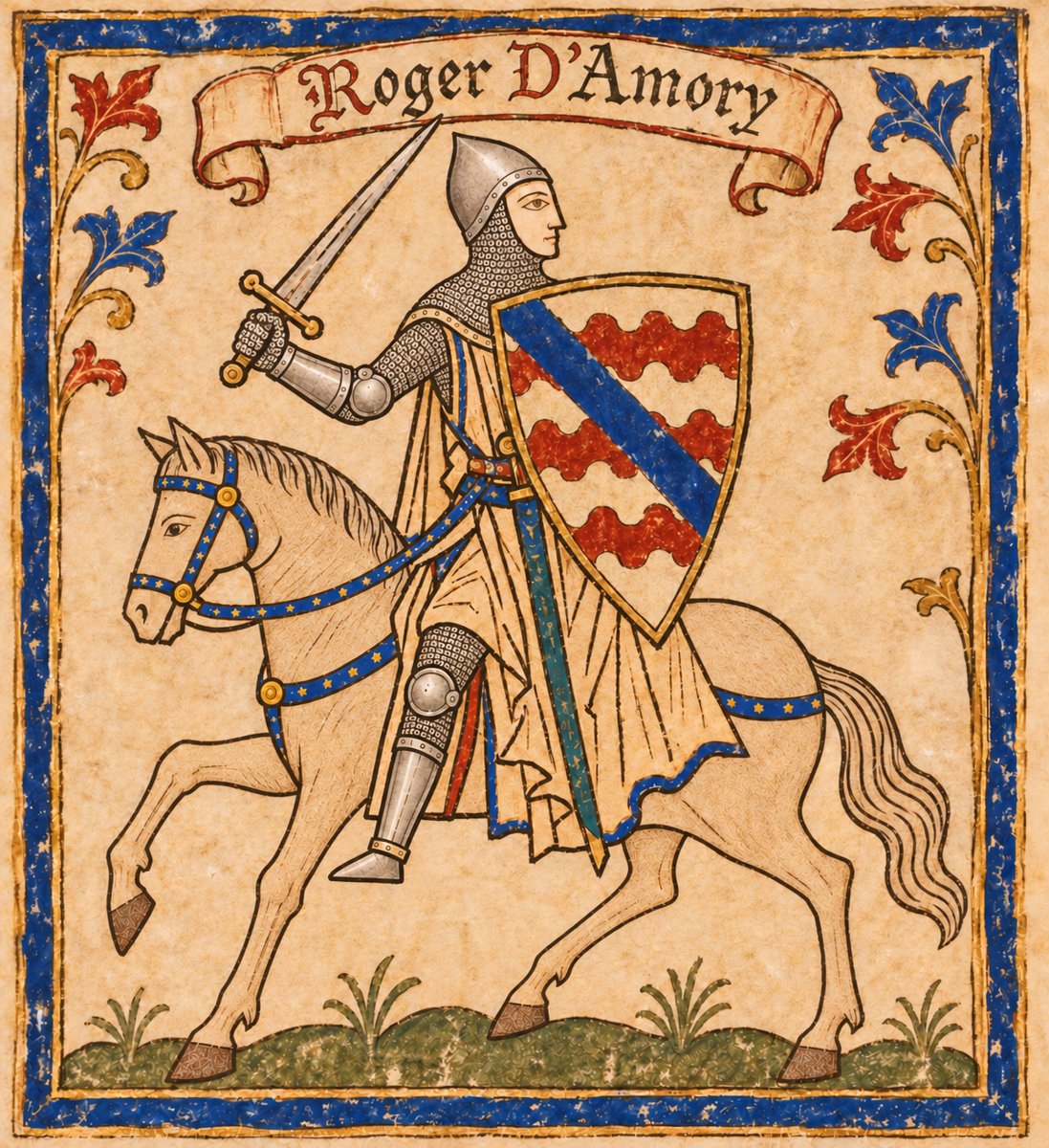
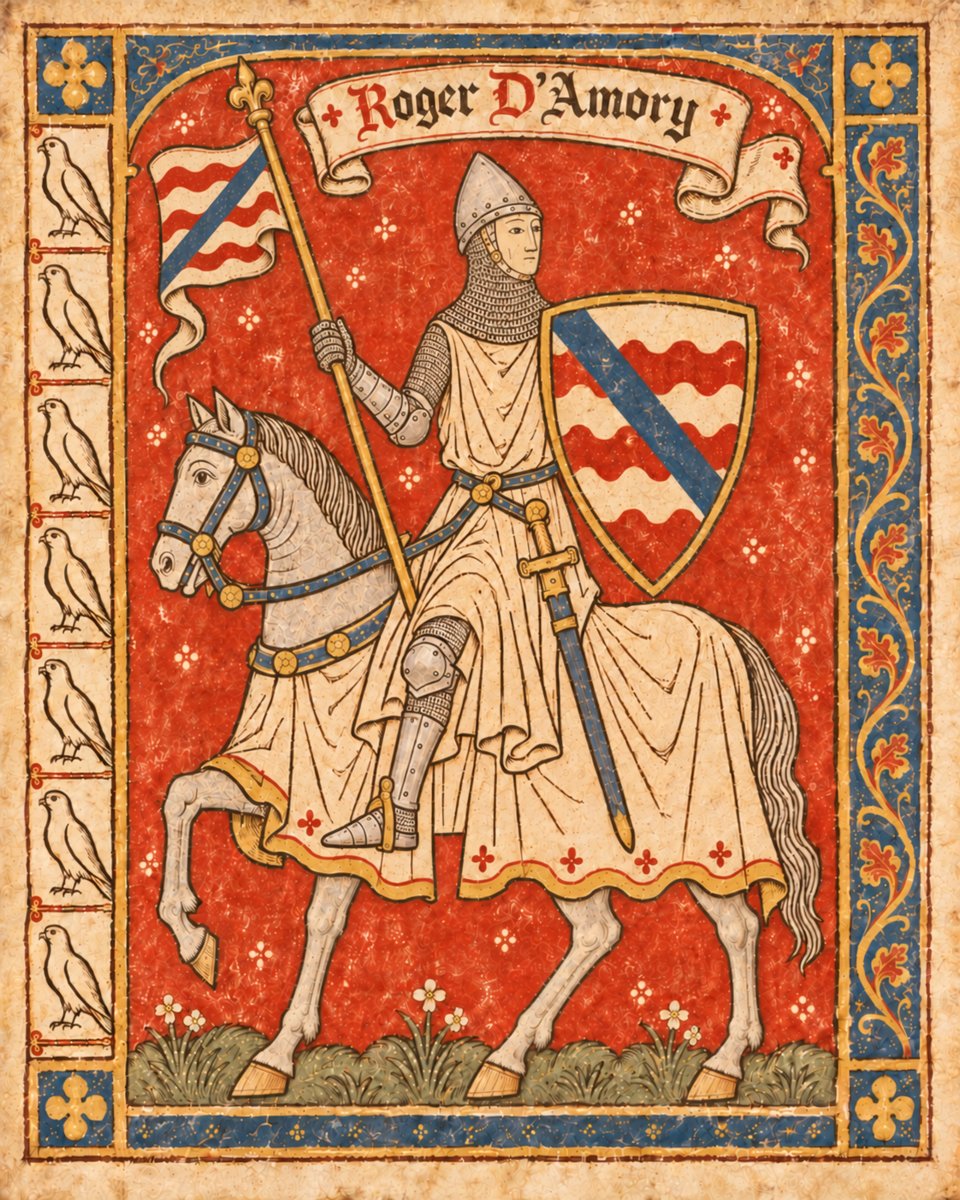
Images of Roger Damory at the head of this page and in section 2 are modern illustrations in the style of a medieval drawing and are AI-generated (OpenAI); not a contemporary likeness.
Use of AI
This paper is not intended as an academic paper. It was generated solely for the damery.family website based on the research required for the site. For that reason, and for speed, Claude (Anthropic) assisted with research and drafting. The author gathered and checked the sources and is responsible for the text.
Roger Damory · Chapter 33: The Damorys · The Damory descent · The Arms